About Aloiampelos ciliaris (Haw.) Klopper & Gideon F.Sm.
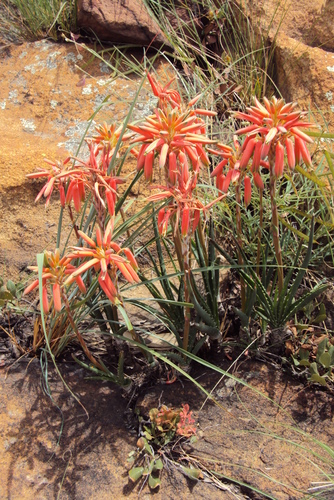
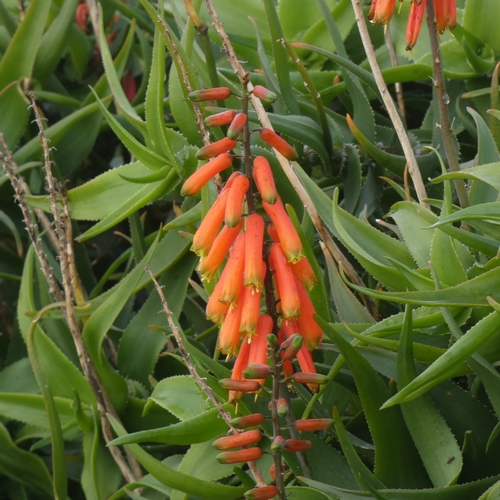
Aloiampelos ciliaris (formerly classified as Aloe ciliaris), commonly known as the common climbing-aloe, is a thin-leaved, generally rapidly growing succulent plant native to Southern Africa. In its native range, Aloiampelos ciliaris is naturally widespread across the coastal, chaparral-like vegetation of the Eastern Cape, extending into the fynbos habitat along the border of the Western Cape. It grows at the bases of dry river canyons and valleys within thorny thickets, where its long stems grow rapidly upward and outward to reach sunlight at the top of canyons. Its recurved leaves function as hooks that let the plant anchor itself into thick vegetation, or grow vertically along rocky hillsides, cliff faces, and canyon walls. The species Aloiampelos ciliaris is thought to have evolved from a smaller, rarer, more delicate plant now classified as the subspecies Aloiampelos ciliaris ssp. tidmarshi, and appears to have spread across its native region relatively recently. This ancestral subspecies remains restricted to the Albany thickets of the Eastern Cape, ranging from Addo Elephant National Park in the west, east through Makhanda to East London. It is also found along the coast at Kenton-on-Sea, Port Alfred, and various areas between these two locations. While Aloiampelos ciliaris was originally only found in the dry vegetation of the Eastern Cape, from the Baviaanskloof mountains to Ciskei, this adaptable species has been introduced globally through the plant trade, and now grows in many regions outside of South Africa. An early introduced population in Kenya was reported in 1950 by botanist G. W. Reynolds. Aloiampelos ciliaris grows very easily from cuttings, and will readily re-sprout from a cut site if pruned. It has been planted in gardens across Southern Africa, and is one of the fastest growing among all aloes and their close relatives. Today, the plant grows in both introduced non-native habitats and home gardens in North America, where it is most common in Southern California and Mexico, but has also been recorded in Florida, Northern California, and South Texas. Further south in Latin America, it is known to grow in the Dominican Republic, Panamá, Argentina, Bolivia, Chile, Perú, and Uruguay. It has even been recorded in the Amazon basin states of Mato Grosso do Sul and Rondônia, Brazil. In Europe, A. ciliaris has been recorded in the Atlantic archipelagos of the Azores and Canary Islands, northern Spain's Asturias region, and Greece. Outside of Africa in the Southern Hemisphere, the species occurs in coastal regions of Australia, where it has been documented in nearly every Australian state except the Northern Territory. It is also known to grow on the North Island of New Zealand.