About Aloe succotrina Weston
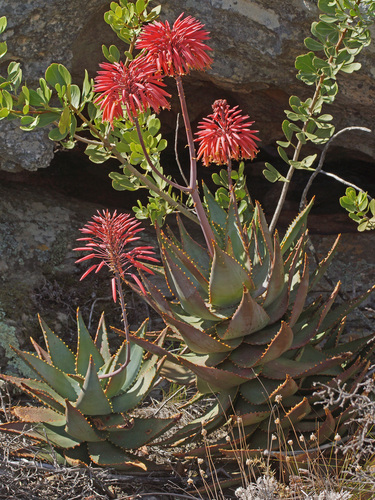
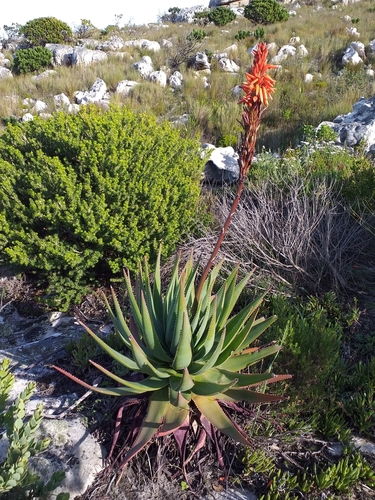
Aloe succotrina Weston forms clusters 1–2 metres (3.3–6.6 ft) in diameter, with leaves arranged in dense rosettes. It flowers in winter, from June to September, producing a tall raceme that bears shiny red flowers pollinated by sunbirds. Taxonomically, it belongs to the Purpurascentes series of very closely related Aloe species, alongside Aloe microstigma, Aloe gariepensis, Aloe khamiesensis and Aloe framesii. Naturally, Aloe succotrina is found from the Cape Peninsula eastward as far as Mossel Bay. It is common in Peninsula Sandstone Fynbos vegetation, and typically grows high on cliff faces and rocky outcrops, areas not reached by seasonal fires. It is one of the few aloes that naturally occur in fynbos habitats, growing alongside the Fan Aloe and Aloiampelos commixta of Table Mountain. It is also one of only three indigenous aloes and their relatives native to the city of Cape Town, together with Aloiampelos commixta and Aloe maculata. Aloe succotrina can be easily grown as an ornamental plant in Mediterranean climate gardens, rockeries, and containers. It is especially attractive when it blooms in winter. It is used in Western Cape gardens for natural landscaping themed around native Fynbos plants. This plant prefers a sunny, well-drained location. Sufficient space must be left for it to reach maturity, as it eventually grows into a large, dense cluster. Fynbos aloe can be propagated either by cuttings or offshoots, or by seed. This species is used as a medicinal plant.