About Aloe pluridens Haw.
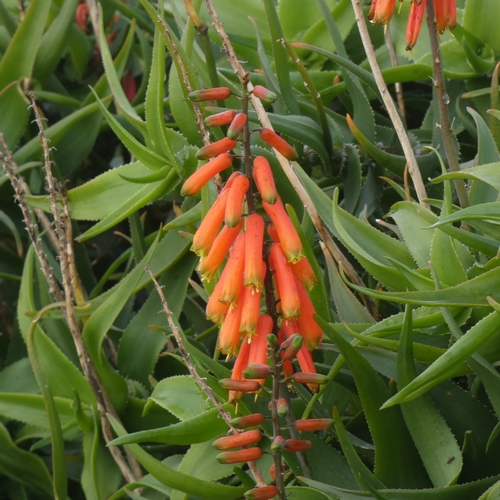
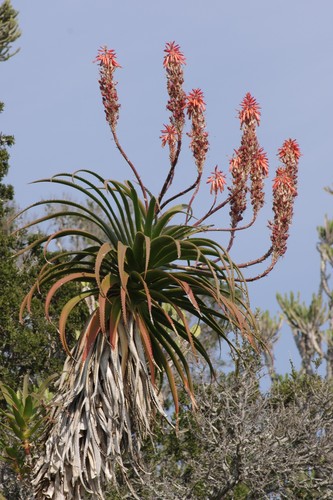
Aloe pluridens Haw., also known as the French Aloe, occasionally grows up to 6 meters in height. It is typically single-stemmed, though it sometimes forms multiple branches when grown in cultivation. Its thin, recurved, light-green leaves grow in an elegant, symmetrical spiral around a central rosette. The leaf margins are lined with large numbers of teeth, which is reflected in its scientific name "pluri-dens", meaning "multiple-teeth"; these teeth are small and pink-white in color. This species is frequently confused with related arborescent aloes including Aloe ferox, Aloe africana, and Aloe excelsa, but it can be distinguished by its thinner, more delicate pale green or yellow-green leaves, and its thinner trunk compared to the robust form of these other species. When it grows in a multi-branched form, it can also resemble the smaller multi-branched Aloe arborescens, but its flowers and distinctive spiral leaf growth set it apart from all these similar species. Its inflorescence usually branches into a maximum of four uniform-coloured, cone-shaped racemes. The flowers are uncurved, and coloured pink or dull scarlet. The French Aloe occurs in a wide coastal belt in South Africa's Eastern Cape Province, ranging from the Kei River mouth to the Humansdorp area. There is also a disjunct set of populations in coastal KwaZulu-Natal. Its native habitat is most often dense succulent thickets, where it frequently grows alongside Aloe ferox, Aloe africana and Aloe speciosa, and hybrids between these species can form. The climate in its native range is moderate, with no frost, and hot, humid summers. Rainfall is spread throughout the year, with an annual total between 600 and 700 mm.