About Aloe microstigma Salm-Dyck
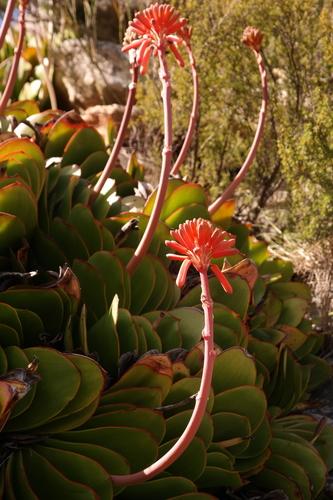
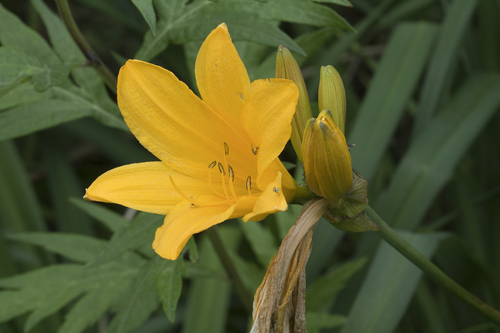
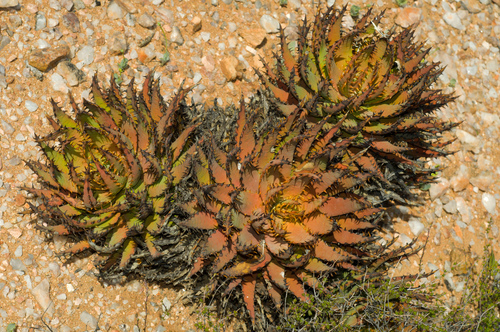
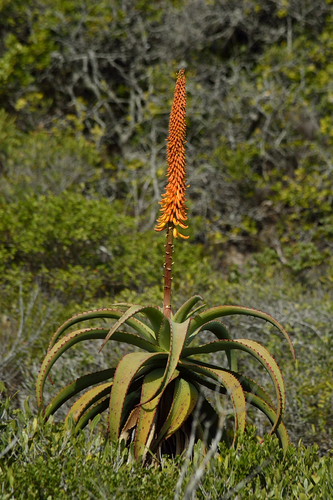
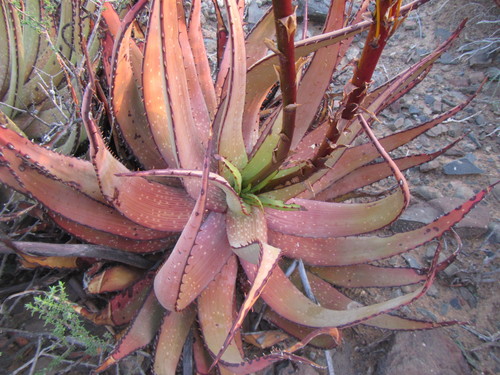
Aloe microstigma was described and illustrated by Prince Salm-Reifferscheid - Dyck in 1854. It is the most widespread aloe in its section, with a disjunct distribution. It is found in the western parts of the Eastern Cape, central Western Cape, extends into the Northern Cape's Tankwa Karoo, and is also present far in the Northern Cape south of the Orange River in South Africa, as well as in south - western Namibia. It grows on rocky outcrops, sometimes on steep slopes, in karroid, desert, semidesert, and Namaqua Broken Veld vegetation. Aloe microstigma is closely related to A. khamiesensis from western South Africa, A. gariepensis from the Orange River Valley in the Northern Cape and southern Namibia, and Aloe pictifolia from the Eastern Cape. Some authors consider A. khamiesensis conspecific with A. microstigma, and some think the eastern form of A. gariepensis is a possible variant of A. microstigma. Aloe pictifolia is also sometimes seen as a close ally. Aloe brunnthaleri is regarded as a yellow - flowering form of A. microstigma. The name Aloe brunnthaleri was a provisional one by Alwin Berger, and it was later validated by Herman Cammerloher. This yellow - flowered form is known from several localities in the Western Cape and Northern Cape, South Africa, and was recently reported from the Gannaga Pass. Namibian plants previously described as A. juttae are now treated as a synonym of A. microstigma, but some think they should be recognized at a specific or subspecific level. The disjunct distribution of A. microstigma populations has been a source of uncertainty, though the distribution gap has recently been reduced. Plants resembling A. microstigma are found in several places in the far Northern Cape's Bushmanland region and in the Richtersveld. They can occur as scattered individuals or in clumps and may mix with A. gariepensis. In the Richtersveld, this aloe is not common, with only two known colonies. There are also two known populations in Namibia's Sperrgebiet. A specimen from the Akkerendam Nature Reserve was initially identified as 'Aloe cf. khamiesensis', but the plant there morphologically resembles A. microstigma. Similar plants in the Calvinia area are experiencing mass die - offs possibly due to aloe snout beetles or porcupine herbivory. In 2012, plants in full flower resembling A. framesii or A. microstigma were found near Kagga Kamma Nature Reserve. Mottram (2013) proposed that the correct name for A. microstigma is A. perfoliata, but due to the confusion around the application of A. perfoliata, the name A. microstigma is preferred until more taxonomic clarity is obtained.