About Aloe juvenna Brandham & S.Carter
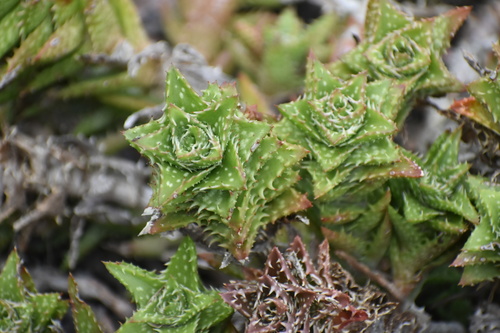
Aloe juvenna Brandham & S.Carter is frequently confused with Aloe squarrosa, a species native to Socotra island. Aloe squarrosa has long, smooth, spotted leaves that curve backward; these recurved leaves are only held around the head or top of each stem, while dead leaves fall from the lower portions of the stem, and it is relatively rare in cultivation. By contrast, Aloe juvenna has many short, straight, compact triangular leaves that are densely packed along its entire stems. It is common in cultivation but extremely rare in its natural habitat. Aloe juvenna is also a tetraploid, meaning it has a double set of chromosomes — 28 instead of 14 — and it does not resemble any other Aloe species native to its region in appearance. It is endemic to Kenya, East Africa, where it is restricted to a small rocky area in the country’s mountainous southwest, near the border with Tanzania. Aloe juvenna was long common in cultivation before its natural origin was confirmed. The first recorded cultivated specimens were found in South Africa. Even though there were rumours that the species originated in Kenya, its exact origins remained a mystery for a long time. It was first thought to be a juvenile Aloe due to its small size, so it was labelled "juvenna", meaning "juvenile" — this label eventually became its formal scientific name. Later, it was hypothesized to be a hybrid, possibly between Aloe distans and Haworthia coarctata, or between Aloe distans and a species of Astroloba. Genetic testing conducted in the 1970s revealed that Aloe juvenna has a doubled set of chromosomes (tetraploidy), which made it more likely that this Aloe originated in East Africa, the region where most other tetraploid aloes are native. The name Aloe juvenna was finally published as a valid species name in 1979. In 1982, an expedition to far southwestern Kenya discovered a small number of wild Aloe juvenna plants growing on a tiny rocky mountain ridge high above tropical rainforest. The discovery of these plants in this remote location confirmed that Aloe juvenna is a distinct natural species. However, the question of how the species was first introduced into cultivation still remains a mystery.