About Aloe excelsa A.Berger
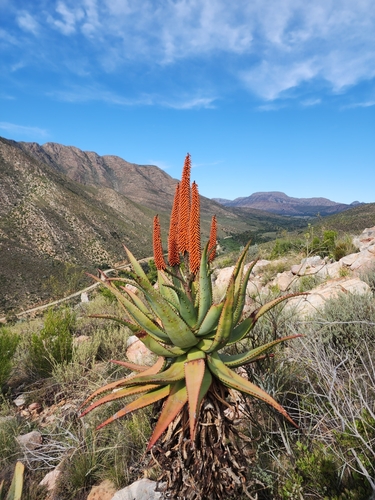
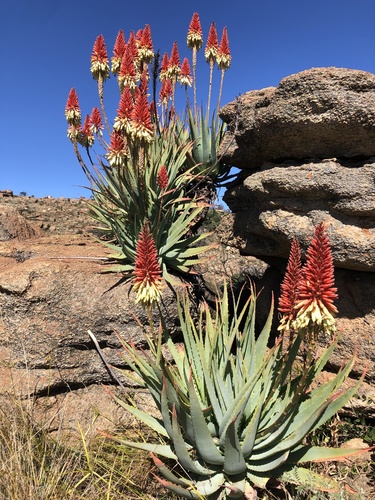
Aloe excelsa A.Berger, commonly known as the Zimbabwe Aloe, is a tall aloe species that sometimes reaches tree-like dimensions of 5–6 metres, though 3 metres is a more common height. It is single-stemmed, and all but the lowest part of its trunk is covered in the remains of dead leaves. Its leaves grow in a compact rosette at the top of the trunk; they spread outward, become recurved, and can reach up to 1 metre long. The leaves are dark green in summer, succulent, and up to 3 cm thick at their centre. Like some other aloe species, young Aloe excelsa plants have many spines across their leaf surfaces. As the plants grow taller and become less vulnerable to grazing, these brown-red spines disappear, remaining only along the leaf margins. This species is often confused with the related Aloe ferox and Aloe africana, which grow further south, and the three look very similar when fully grown. However, their flowers differ: the racemes of Aloe excelsa are much shorter and slightly curved. The Zimbabwe Aloe gets its name from the large number of specimens that grow around the ruins of Great Zimbabwe, where the species has drawn attention for its large size and distinct shape. It occurs in a relatively small area of south-central Africa. Its southern limit is the Magato mountains in Limpopo province, South Africa; from there it ranges north along the southern side of Zimbabwe’s central watershed, extending into hilly areas on the south side of the Zambezi river in Mozambique. Two outlying populations mark its northern limits, one around Mulanje mountain in Malawi and another in Kafue Gorge, just across the Zambezi river in Zambia. Within this range, the species grows best in areas with good drainage and moderately stable soils, such as rocky, wooded hillsides. It is restricted to its current range by too much dry season heat further north, and cold winter winds further south. It can tolerate light frost during its resting and flowering season, which occurs occasionally at its favoured altitudes of 800–1600 metres. Aloe excelsa has caught the interest of gardeners and park planners for its imposing appearance and tolerance of a wide range of growing conditions. In its natural habitat, it grows best when it receives plenty of water during its growing season, and requires a distinct dry period with cooler conditions when its impressive flowers develop.