About Aloe comosa Marloth & A.Berger
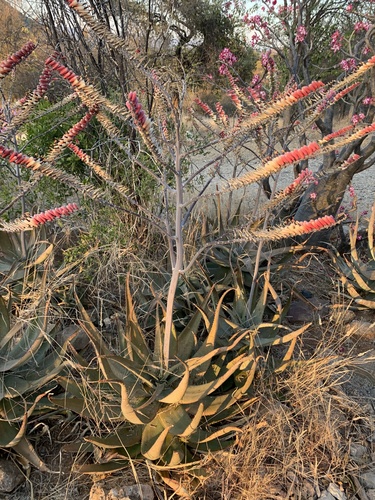
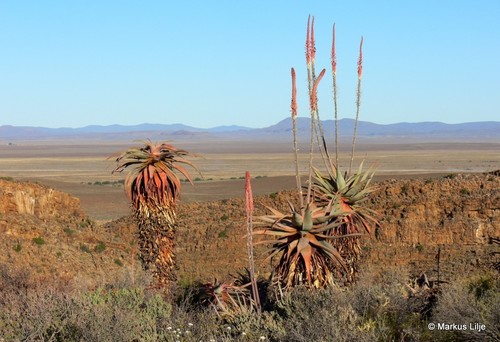
Aloe comosa Marloth & A.Berger is classified as a tree aloe. It has a single unbranched erect stem that can grow to around 3 meters tall. Mature plants retain dry dead leaves, which form a tangled skirt- or beard-like mass around the stem. Unlike the bark of woody dicots, Aloe comosa bark does not contain phellogen (the meristematic tissue that develops into bark); instead, aloe bark is made up of overlapping, irregular layers of incomplete bark tissues. This species produces thick, succulent lanceolate leaves around 2 feet (0.6 meters) long, with smooth glabrous surfaces. Leaf edges are entire, curved upwards (involute), and lined with spiny, tooth-like brown-red thorns. Leaves grow in a whorled arrangement from a rosette at the top of the erect stem. Researchers have studied why many tree aloe species retain dead leaves. Earlier hypotheses suggested dead leaves protected bare bark from daytime sun and nighttime cold, or that the thorny mass of dead leaves deterred wildlife seeking water, nectar, or seeds. A 1983 study proposed that dead-leaf retention evolved to create thick, fire-resistant bark in fire-prone habitats. Aloe comosa grows only in a very small area of the Western Cape province of South Africa. It was first discovered in 1905 in the Olifants River Valley, north of the town of Clanwilliam, which inspired its common name. As an angiosperm, Aloe comosa follows the standard angiosperm life cycle. Like most South African aloes, it blooms in summer. Tall inflorescences (flower stems) up to 2 meters (6.7 feet) high branch from the leaf rosette. The tips of these inflorescences hold flower spikes made of many small, tightly packed flowers. The flower spikes are usually rosy-cream to ivory-pink, paler at the base and darker pink toward the top. Bees are the main pollinators of Aloe comosa, though evening moths may also contribute to pollination. Seed capsules mature and seeds are produced in late February and early March each year, timed for the Southern Hemisphere's winter rains. When seed capsules turn pale green, they split open to reveal flat brown seeds. Each seed is surrounded by a thin transparent membrane that aids in seed dispersal. Sufficient wind carries the seeds some distance from the parent plant, and seeds most often germinate under the cover of a nurse plant. The Aloe genus currently includes over 650 species. A small number of Aloe species have uses in treating minor thermal burns, itching, and sunburn, by applying the plant's thick mucilaginous gel directly to the skin, but Aloe comosa is not one of these used species. Its only known uses are as a decorative house plant and a collector's item. Though it is native to South Africa's Western Cape, experienced collectors and horticulturalists can grow Aloe comosa outdoors in regions like Arizona and California, or in desert climate greenhouses.