About Aloe broomii Schönland
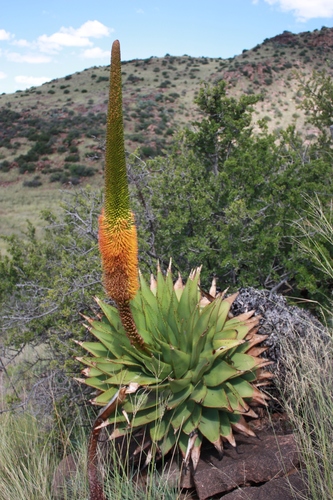
Aloe broomii Schönland is a robust short-stemmed aloe that reaches up to 1.5 metres in height including its inflorescence. It is typically single-stemmed, though it may occasionally form groups of up to three rosettes. Like other aloes, it has fleshy succulent leaves edged with small thorns. Compared to the green or white thorns of many other aloe species, the thorns of Aloe broomii are very dark. Its most notable feature is its unusual inflorescence: the flowers are hidden by extended bracts, which gives the inflorescence a sinuous, snake-like shape, reflected in the species common name. This aloe is widespread across South Africa and Lesotho. In South Africa, its range extends from Limpopo Province (South Africa's northernmost province, which shares borders with Mozambique, Zimbabwe and Botswana) south to Beaufort West in the Northern Cape, east to the Free State (which borders the landlocked enclave of Lesotho), and further south and east to the Eastern Cape. It grows on rocky slopes in hilly and mountainous areas, at altitudes between 1000 and 2000 metres above sea level. The areas it inhabits receive low annual rainfall, ranging from 300 to 500 mm per year, which falls mainly in summer. Like other aloes, Aloe broomii attracts a wide variety of pollinators, including insects such as bees, wasps and ants, and bird species such as sunbirds. Its seeds may be attacked by weevils. Like many other Aloe species including the well-known Aloe vera, Aloe broomii is considered to have medicinal properties. Farmers use it as a disinfectant, as an ear remedy for sheep, and as a pesticide to remove ticks from livestock. Like most Aloe species, it is a water-wise plant suitable for use in xeriscaping. It grows well in well-drained soil and thrives in full sun. It is propagated from seed.