About Aloe arborescens Mill.
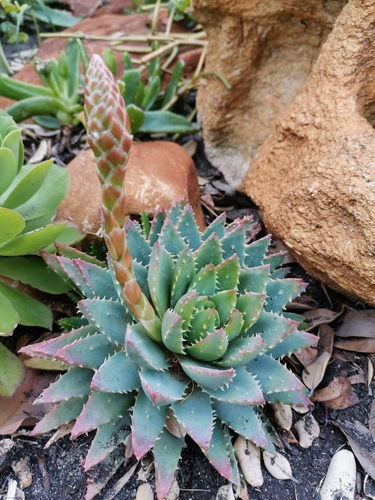
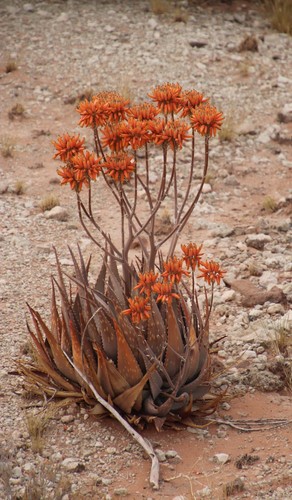
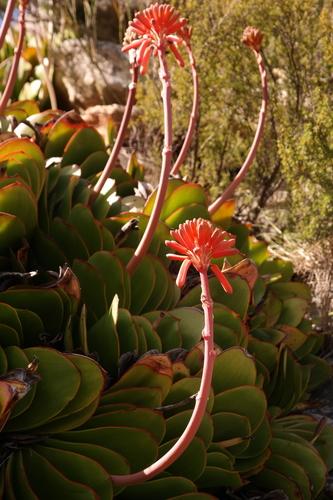
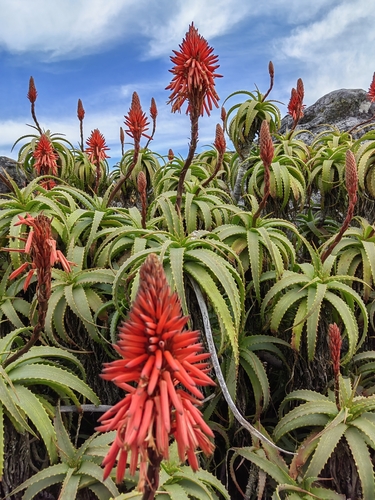
Aloe arborescens Mill. is a large, multi-headed, sprawling succulent. Its specific name indicates that it sometimes reaches tree size. A typical height for this species is 2–3 metres (6.6–9.8 ft). Its leaves are succulent, green with a slight blue tint, with small spikes along their edges, and arranged in rosettes at the end of branches. Its flowers grow in an inflorescence called a raceme. The racemes are unbranched, but two to several can sprout from each rosette. Individual flowers are cylindrical and have a vibrant red-orange color. Taxonomically, it is part of the Arborescentes series of very closely related Aloe species, along with Aloe pluridens and Aloe mutabilis. Aloe arborescens is endemic to the south eastern part of Southern Africa. Specifically, its native range includes South Africa, Malawi, Mozambique, and Zimbabwe. It has the third largest distribution among species in the aloe genus. Although it has adapted to many different habitats, its natural habitat is usually mountainous areas, including rocky outcrops and exposed ridges. Its common name krantz aloe comes from the Afrikaans word "krans", meaning a rocky cliff, whose spelling may have been influenced by the German "Kranz". Its habitat can vary, and it is one of only a few aloe species that grows from sea level up to mountain tops. It is also widely distributed and naturalized in the western Mediterranean, Australia, California, Japan, South Korea and the Marshall Islands, and it is an invasive species in Portugal. In cultivation, gardeners value Aloe arborescens for its succulent green leaves, large vibrantly-colored flowers, and winter blooming. Its sweet nectar attracts birds, butterflies, and bees. With a minimum tolerated temperature of 10 °C (50 °F), it is grown under glass in temperate regions. The cultivar A. arborescens 'Variegata' has gained the Royal Horticultural Society's Award of Garden Merit. In Southern Africa, Aloe arborescens is traditionally planted around kraals, which are domestic stock enclosures, to act as a living fence or security hedge. Old abandoned kraals can often still be identified many years later because the Aloe arborescens planted around them persist. This species is easily propagated by cuttings.