About Alnus serrulata (Aiton) Willd.
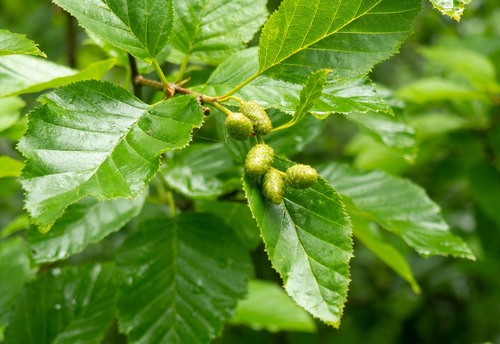
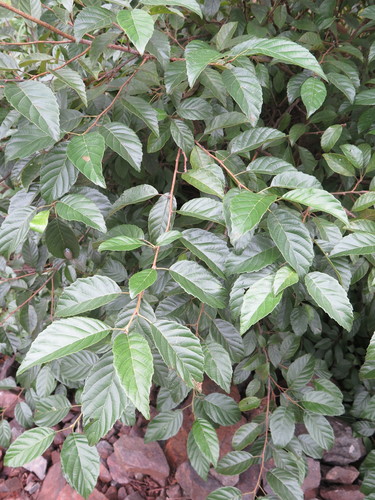
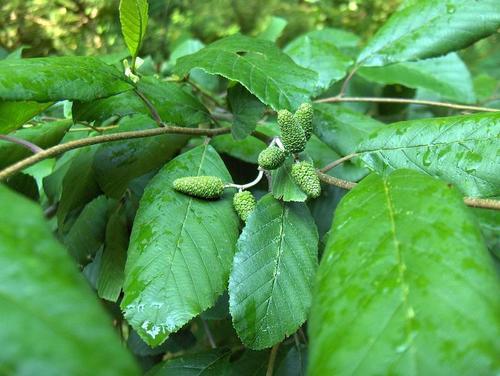
Alnus serrulata (Aiton) Willd. is a large shrub or small tree that commonly grows 2.4–3.7 m (8–12 feet) high; in exceptional cases it can reach 9.1 m (30 ft) in height and 5.9 in (15 centimetres) in diameter. Its scientific name derives from alnus, an old term for alder, while serrulata refers to the species’ characteristic finely-toothed leaf margins. This plant takes around 10 years to reach maturity. It prefers moist soil near streams, pond margins, and riversides, and can grow rooted below the water line, though it may also be found growing on hills. It usually produces multiple stems from its base, and bears reddish-green flowers. Its broad, flat, dark green leaves are roughly 2 to 4 inches long. The leaves of Alnus serrulata are simple, round, and obovate, measuring 7.6 to 12.7 cm (3 to 5 in) long and 1.2 to 2.8 in wide. They are obtuse, widest at the middle, and have a V-shaped base. The pinnate veins are conspicuous. Leaves have a smooth texture on the upper surface and a hairy texture on the lower surface; the upper side is dark green, while the underside is pale green. Alnus serrulata is monoecious, meaning both male and female flowers are borne on a single plant. Male staminate catkins are 1.6 to 2.4 inches long, while female pistillate catkins are 1/2 inch long. The reddish-green flowers open between March and April. The fruit of Alnus serrulata is ovate, dark brown, hard, and cone-like, with winged scales. Seeds are produced inside these small cones and do not have wings. Fruit typically matures in fall and remains persistent on the plant for a long time. The twigs are reddish-brown and have a three-angled pith; young twigs are covered in hairs. The bark is brownish gray, smooth, and has a bitter and astringent taste. Alnus serrulata is distributed primarily across eastern North America. Its range extends from Maine to northern Florida, west to southeastern Oklahoma, Missouri, and Illinois, and it also grows along the Mississippi River. It is not found in northern New Hampshire or Vermont. It is classified as a facultative wetland species in the Atlantic and Gulf Coastal Plains, and an obligate wetland species in the North and Midwest. In cultivation, Alnus serrulata naturally occurs in habitats including streambanks, riversides, and swamps. It has high water needs, and requires full sun or partial shade. It also needs moist soil with a pH between 6.8 and 7.2. In wildlife habitat, it requires 5–10 feet of spacing between individual plants. Because it grows along riversides and streambanks, Alnus serrulata is commonly used as a stabilizer and restorer for these habitats. It has been used to address astringent, diuretic, emetic, ophthalmic, and purgative concerns. Native Americans used a tea made from the bark of this plant to treat diarrhea, coughs, toothaches, sore mouth, and the pain of childbirth. It has also been used as a skin wash to treat acne. An extract from the bark has been used to make an orange dye.