About Alnus nepalensis D.Don
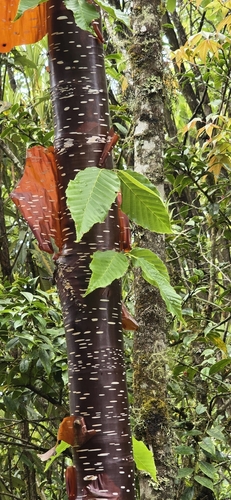
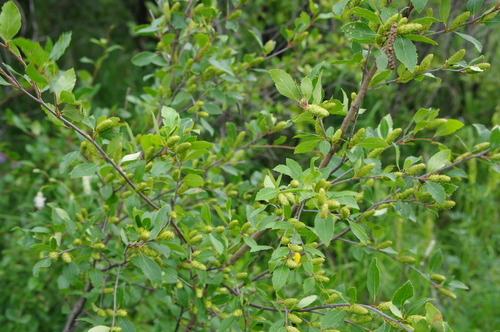
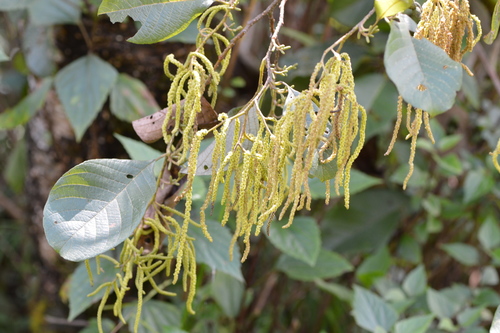
Alnus nepalensis D.Don is a large deciduous alder with silver-gray bark. Mature individuals can reach up to 30 m in height and 60 cm in trunk diameter. Its leaves are alternate, simple, and shallowly toothed, with prominent parallel veins; leaves measure 7–16 cm long and 5–10 cm broad. This species produces flowers in catkins, with separate male and female flowers that both grow on the same individual tree. Male catkins are pendulous and 10 to 25 cm (4 to 10 inches) long, while female catkins are erect and 1 to 2 cm (0.4 to 0.8 inches) long. Up to eight female catines grow together in axillary racemes. Unusually for alders, this species flowers in autumn, and its seeds mature the following year. This alder occurs across the Himalaya at elevations between 500–3000 m, ranging from Pakistan through India, Nepal, and Bhutan to Yunnan in southwest China. It grows best on deep volcanic loamy soils, but it can also grow in clay, sand, and gravel. It tolerates a wide variety of soil types, grows well in very wet areas, requires ample soil moisture, prefers streamside locations, and can also grow on slopes. Alnus nepalensis is a fast-growing tree, and it is sometimes planted for erosion control on hillsides and for land recovery in shifting cultivation. It has nitrogen-fixing nodules on its roots. Its wood is moderately soft. The wood is occasionally used for box-making and light construction, but it is mainly used as firewood that burns evenly but rather quickly, and for making charcoal. Currently, indigenous ethnic groups including the H'mong, Nung, and Thu Lao in Simacai district, Lao Cai province, Northern Vietnam prefer this tree species for forest regreening and enrichment through local knowledge (SPERI, CENDI).