About Allophylus natalensis (Sond.) de Winter
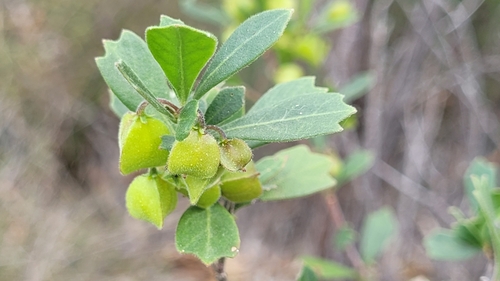
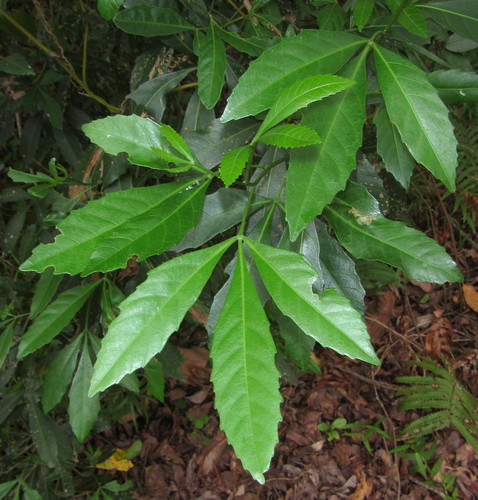
Allophylus natalensis (Sond.) de Winter is a small evergreen plant that can grow as a single-stemmed tree up to 5 m (16 ft) tall, or as a multi-stemmed bush with shorter stems. Its bark is greyish-brown, and can either have a smooth texture or develop wrinkles. Smaller branches are greyish-white and downy. The leaves grow on long petioles and are trifoliate, with three nearly stalkless, elliptical leaflets. Leaflets measure 35 to 85 mm (1.4 to 3.3 in) long and 10 to 20 mm (0.4 to 0.8 in) wide; they are leathery and stiff, glossy green on the upper surface and pale green on the lower surface, with shallowly toothed margins. Small fragrant flowers grow in spike-like racemes in leaf axils, and are followed by large numbers of red, globular berries 7 mm (0.3 in) in diameter. Flowering occurs in autumn, between March and May, and the berries ripen in late winter, between June and August. This species is native to Eastern Cape Province and KwaZulu-Natal in South Africa, as well as southern Mozambique. Its natural habitat is coastal dune forest and scrub, where it often grows alongside Mimusops afra, Apodytes dimidiata, and Canthium obovatum. The flowers of Allophylus natalensis are pollinated by butterflies. Both birds, which disperse the plant's seeds, and humans consume and enjoy the berries. Foliage is eaten by the larvae of the pearl emperor butterfly (Charaxes varanes subsp. vologeses). Leaves are mined by the larvae of Corethrovalva goniosema, a moth in the family Gracillariidae, and by the larvae of Stigmella allophylica, a moth in the family Nepticulidae.