About Allopeas gracile (T.Hutton, 1834)
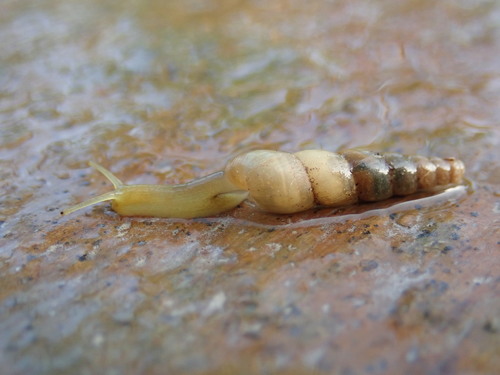
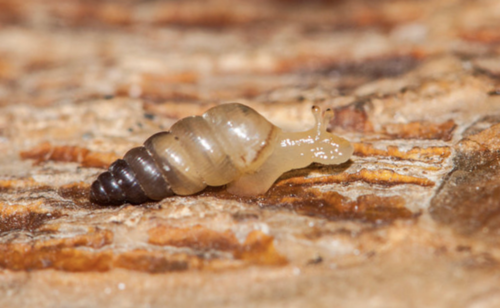
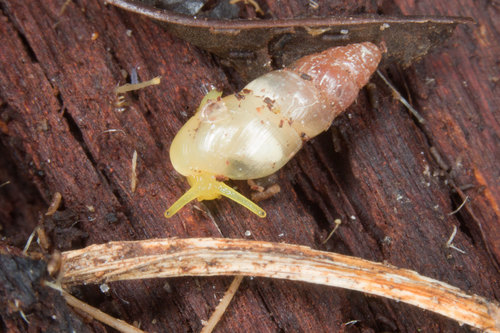
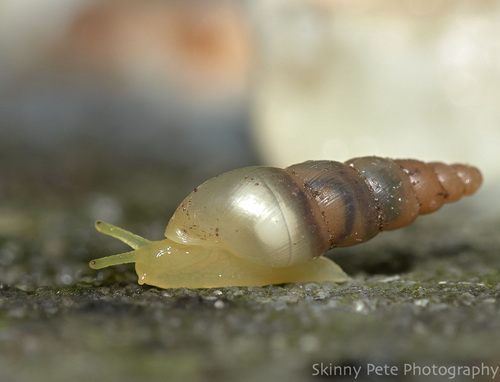
Allopeas gracile (T.Hutton, 1834) is a species of gastropod. Two different descriptive accounts of this species exist. The original description states that the shell length ranges from 9.8 mm to 12.1 mm, and shell diameter ranges from 2.9 mm to 3.3 mm. In the original description, the soft body has four retractile tentacles: the upper pair is longer, and bears eyes at their tips. The foot is elongated, rounded at the rear, and truncated at the front, with a pale yellowish color. In the original description, the shell is transparent, thin, nearly colorless, with a gradually tapering spire. It has 12 whorls, and the body whorl is the same size as the two whorls that come before it. The aperture is semi-ovate, longer than it is wide. The columellar lip is straight and slightly reflected, while the outer lip has a fine edge. A more recent description notes that the shell is conically elongated and slender, with a translucent, glossy surface that is pale yellowish in hue. It has 7½ to 8 whorls, tapering gradually toward a blunt apex. The protoconch is made of around two smooth whorls, while later whorls are marked with fine, densely packed, obliquely arranged riblets. The spire tapers evenly, and the whorls are flatly convex with a wide, shallow suture. The last whorl is the largest. The aperture is tall and oblong, with a thin peristome. The columellar margin near the umbilicus is slightly expanded, and the columella itself is straight. The umbilicus is narrowly open. Allopeas gracile is distributed throughout the world's tropics and subtropics. It is native to India. It is naturalized in Hawaii and the islands of Polynesia. It is present in Australia, specifically in New South Wales, Northern Territory, Queensland, and Western Australia. It is also found in the West Indies, southern Mexico, Central America, and South America. It was introduced to Dominica, where it was first reported in 2009. It also occurs in Tanzania. Outside of its natural range, it lives in greenhouses in other regions, where it is considered a "hothouse exotic".