About Allolobophora chlorotica (Savigny, 1826)
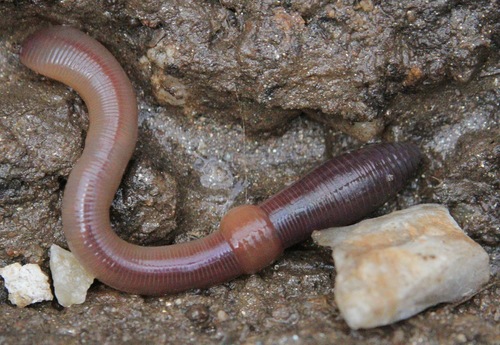
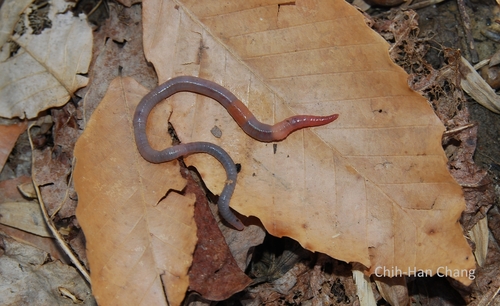
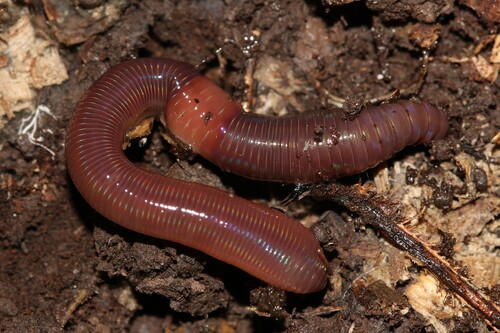
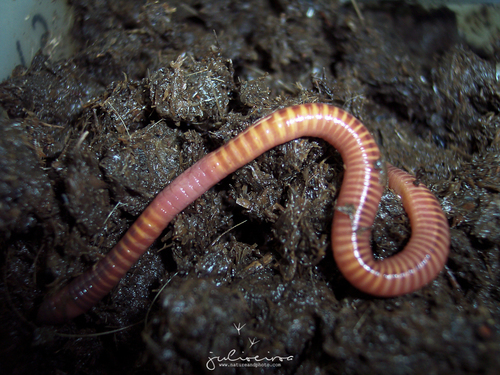
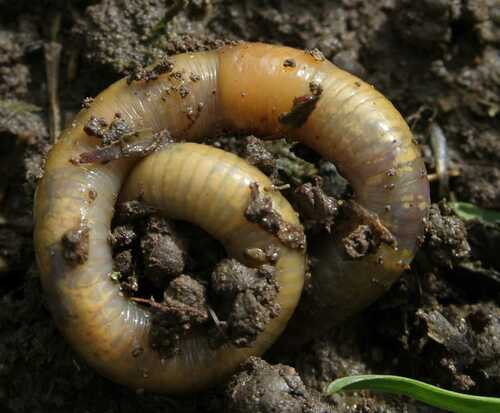
Allolobophora chlorotica, commonly known as the green worm, is an earthworm species that lives and feeds in soil. It can be distinguished from other earthworms by the presence of three pairs of sucker-like discs on the underside of its clitellum. Examination of A. chlorotica specimens from many parts of the British Isles shows that this species has two distinct forms: one with green pigment in its body wall, and one that lacks this pigment, appearing pink.
Allolobophora chlorotica is native to the Palearctic, a region that includes Europe, Asia north of the Himalaya foothills, North Africa, and the northern and central parts of the Arabian Peninsula. It has now been introduced to North and South America, Africa, and New Zealand. It occurs in a wide range of habitats, from arable land and woodland to residential front lawns. In one British study, this species was recorded in all habitats except pine woodland and mires. It is often the numerically dominant earthworm species in England, especially in neutral to base-rich grasslands and arable soils.
As an endogeic worm, A. chlorotica builds complex lateral burrow systems through all layers of the upper mineral soil. This species rarely comes to the surface, and spends its entire life within these burrow systems, where it feeds on mineral soil and decayed organic matter. By definition, endogeic worms live in topsoil or subsoil, feed on soil, burrow and cast within soil, and create horizontal burrows in the upper 10–30 cm of soil.
Pure populations of the pink morph can be found in gardens and woodlands. The green morph occurs in grasslands, ditches, stream and lake banks, and among the roots of aquatic plants such as reed mace. In northern England, mixed populations of both pink and green morphs have been found in grasslands.
A 1959 survey of 17 sites in northern England that host A. chlorotica populations indicated a possible relationship between soil moisture levels and the distribution of the two colour morphs. The survey found that sites with soil moisture content greater than 40% supported populations made up of more than 90% green morphs. Researchers have suggested that it may not be soil moisture content alone that affects morph distribution, but rather the availability of soil water to the earthworms that is the important factor.