About Allogalathea elegans (Adams & White, 1848)
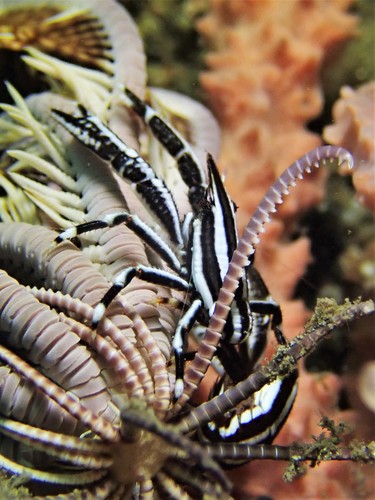
Allogalathea elegans (Adams & White, 1848) is a species of squat lobster that is bilaterally symmetrical, like other members of its group. Its cephalothorax is teardrop-shaped, ending at a triangular rostrum that sits between the animal’s two stalked eyes. The rostrum itself is elongated, flattened along its dorsal side, and variable in length, with between five and nine teeth along its lateral edges. The first pair of legs, called chelipeds, are tipped with pincers and longer than the animal’s entire body. The last pair of legs is reduced in size. The body, and especially the legs, are covered in small fine hairs. Adult body size differs by sex: females are typically larger than males, but neither sex grows longer than 2 centimetres (0.79 in). The animal’s coloration is highly variable, and often matches the color of its host crinoid, though this is not always the case. Color can be uniform, ranging from dark red and blackish-purple to orange or brown. Most observed individuals have longitudinal stripes that vary in thickness, number, and shade. Allogalathea elegans inhabits tropical waters across the Indo-Pacific region, including the Red Sea. Its range extends from the eastern coast of Africa to the Fiji Islands, and from Japan to southern Australia; it has also been newly recorded in Korean waters. This species is a commensal of crinoids, living directly on the body of feather stars. It gains protection and a suitable feeding surface from its host; it can survive for a short time without a host, but its lifespan is shortened when it lacks protection from predators. It is most commonly found in shallow waters, at depths between 0 and 146 metres (0 to 479 ft). When mating conditions are right, Allogalathea elegans engages in precopulatory mating rituals that rely on a range of sensory cues. Females are multiple spawners that lay eggs which hatch into free-swimming larvae. Most females produce three or four separate broods during a single annual reproductive season. Breeding females show both group-synchronous gonadal development and synchronous breeding. Allogalathea elegans develops through four zoeal larval stages before reaching the megalopal stage, after which it grows into a juvenile and then a mature adult. The four zoeal stages together last between 13 and 16 days total. From the megalopal stage onward, Allogalathea elegans resembles a small version of the adult until it reaches full maturity.