About Allocnemis leucosticta Selys, 1863
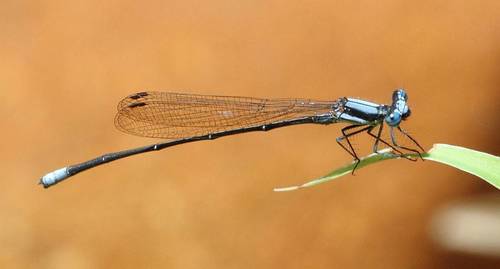
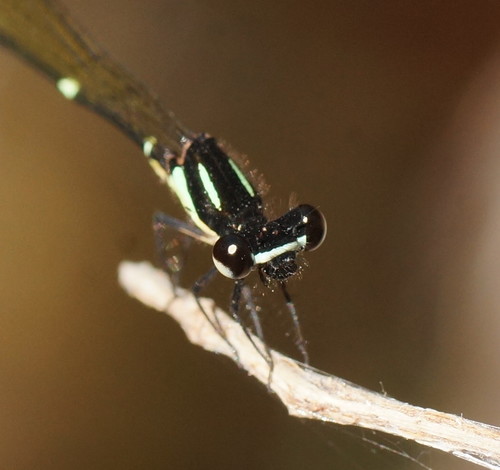
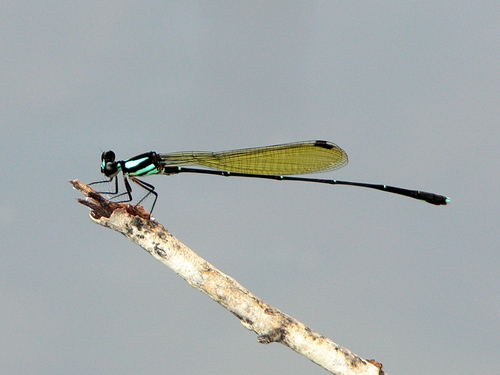
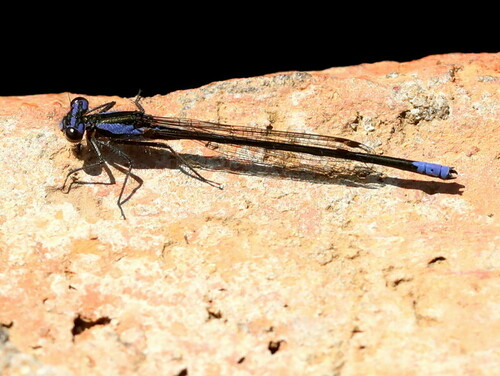
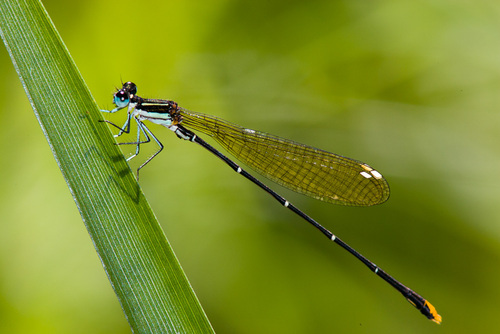
This highly distinctive medium-sized damselfly has a 50 mm (2.0 in) wingspan, and is easily distinguished from other regional species. It has a blue face that extends below its eyes. Its long, slender dark abdomen features narrow white bands at each segment. Its wings are smoky yellow-brown, with diagnostic white pterostigmata that form a wide wing spot near the tip. The white pterostigmata and yellowish wings are clearly visible in flight, simplifying identification. Males and females look remarkably similar, and only the tip of the thorax differs: male thorax tips are gold, while female thorax tips may be gold, pale blue or white. This species is commonly called goldtail, and is mainly found in mid to high altitude escarpment areas of South Africa and Eswatini. It also occurs at sea level in some parts of KwaZulu-Natal and the Southern Cape. Its range stretches from Table Mountain in the Western Cape to the Soutpansberg in Limpopo. It is common but localised across its range due to specific habitat requirements. This damselfly prefers clear, shallow streams. Nymphs live under stones in the weak-current backwaters of these streams. It is most commonly found in shady habitats, including forested or well-wooded streams, rivers, and wooded ravines. It is occasionally found around less shaded streams surrounded by grass and bushes, particularly in fynbos and montane grassland habitats. This species is most active from October to April, which corresponds to spring to early autumn. They almost always perch on twigs, stems, or vegetation over or near water. Males are highly noticeable when they sit in exposed positions over streams in dappled sunlight. Females are often found near males, but are less numerous and less conspicuous. After mating, the male continues to clasp the female behind her head and hold her as she dangles vertically with her abdomen submerged in water. This positioning lets the female lay her eggs in rotten submerged twigs.