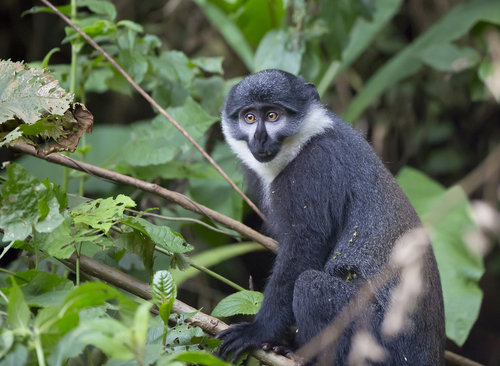
About Allochrocebus lhoesti (Sclater, 1899)
Allochrocebus lhoesti (previously referenced as Cercopithecus lhoesti, or L'Hoest's monkey) has a short dark brown coat, with chestnut coloring across its back and a dark belly. Its cheeks are light gray, and it has a pale moustache along with a characteristic prominent white bib. The species has a body length of 12.5 to 27 inches (32 to 69 cm), paired with a 19-to-39-inch (48 to 99 cm) tail. Adult males weigh around 6 kilograms (13 lb), while smaller adult females weigh 3.5 kilograms (7.7 lb). Its tail is long and has a hook-shaped end. Newborns of this species are born fully furred and with their eyes open.
L'Hoest's monkey is distributed across northeastern Democratic Republic of the Congo, Rwanda, Burundi, and western Uganda. It is a forest-dwelling primate, most typical of moist, high-altitude primary forests, but it occupies a variety of forested habitats including gallery forest, mature lowland rain forests, wooded savanna on mountain slopes, and forest borders. It can also live on cultivated lands. In lowland forests, it prefers regenerating forest areas, while in mountain regions it typically frequents mature, tangled undergrowth beneath broken canopies. Recorded elevations for the species vary between studies: one study only found populations above 900 metres (3,000 ft), another recorded the species as low as 610 metres (2,000 ft), and a third mostly observed the species between 1,500 to 2,500 metres (4,900 to 8,200 ft).
L'Hoest's monkey breeds seasonally, with breeding timing varying by location. Gestation lasts around five months, after which a single young is born. Birth typically occurs at night, wherever the mother is located at the time, and usually falls at the end of the dry season. This timing allows lactation to occur when rainfall is highest. After birth, the mother eats the placenta and licks the newborn clean while the young clings to her belly. Other females in the social group show significant interest in the newborn and will attempt to hold it. Nursing becomes less frequent after a few months, but continues until around two years of age, when the mother gives birth to another offspring. When male offspring reach sexual maturity, they leave their natal group. Individuals of this species have been recorded living more than 30 years in captivity.