About Allocasuarina verticillata (Lam.) L.A.S.Johnson
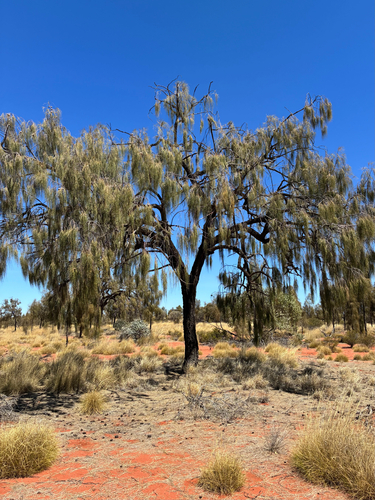
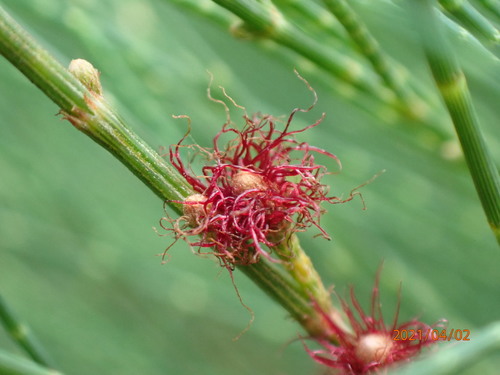
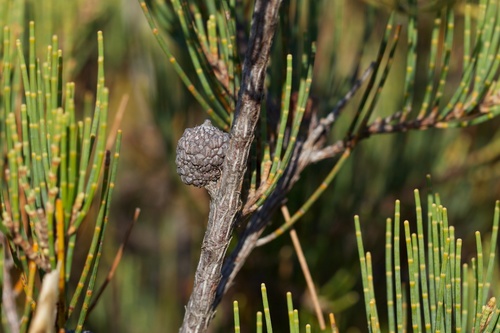
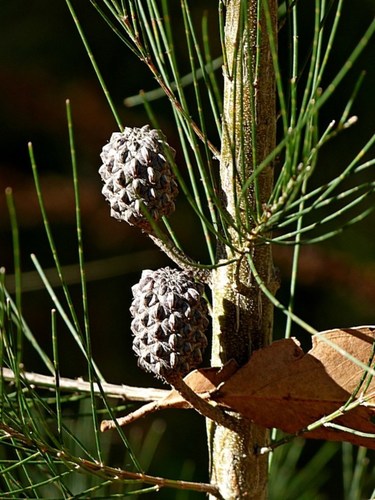
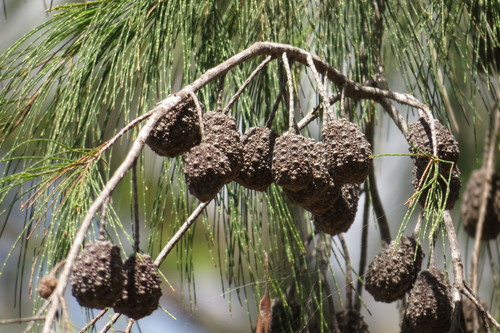
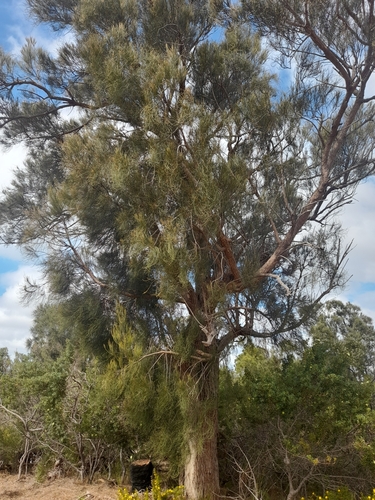
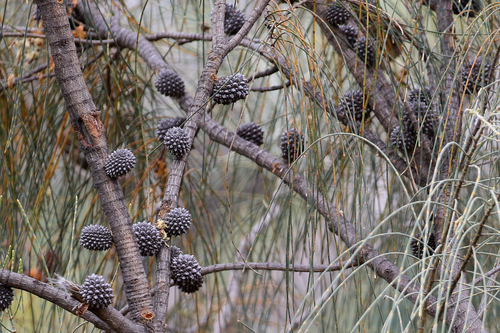
Allocasuarina verticillata (Lam.) L.A.S.Johnson is a small dioecious tree that typically reaches a height of 4–10 m (13–33 ft). It has fissured bark, and its penultimate branchlets are woody. The main branchlets grow up to 400 mm (16 in) long, and its true leaves are reduced to small, spreading teeth 0.7–1.2 mm (0.03–0.05 in) long. These leaf teeth are usually arranged in whorls of nine to thirteen around the branchlets. The sections of branchlet between each whorl of leaves are 15–40 mm (0.6–2 in) long and 0.7–1.5 mm (0.03–0.06 in) in diameter, and are broader at the end near the leaf teeth. Male flowers are arranged in spikes 30–120 mm (1–5 in) long, with around 2.5 to 4 whorls of flowers per cm (0.4 in), and anthers 1.2–2.5 mm (0.05–0.1 in) long. Female cones are either sessile or borne on a peduncle up to 10 mm (0.4 in) long. Mature cones are cylindrical to barrel-shaped, 25–50 mm (1–2 in) long and 17–30 mm (0.7–1 in) in diameter, and contain dark brown, winged seeds called samaras that are 7–12 mm (0.3–0.5 in) long. This species flowers in all months of the year. Allocasuarina verticillata most commonly grows in grassy woodland, where it sometimes forms pure stands and sometimes grows alongside eucalypts. It also occurs on rocky sea coasts and on dry inland ridges. In New South Wales, it grows on rocky hills south of Cobar and on coastal shale south of Sydney. It is widespread across Victoria, and extends west into South Australia, where it occurs in the Flinders Ranges, Gawler Ranges, western Eyre Peninsula, and Kangaroo Island. In Tasmania, it is found near Launceston and along the east coast as far south as Hobart and the Tasman Peninsula. On Kangaroo Island, Allocasuarina verticillata is the preferred food of the glossy black cockatoo. The cockatoos hold the tree's cones in their feet, shred the cones with their strong bills, then remove the seeds with their tongues. Aboriginal Australians use this tree for a range of purposes. The Ngunnawal people make tools including boomerangs from the tree's timber, and mature cones are used as children's toys.