About Allocasuarina torulosa (Aiton) L.A.S.Johnson
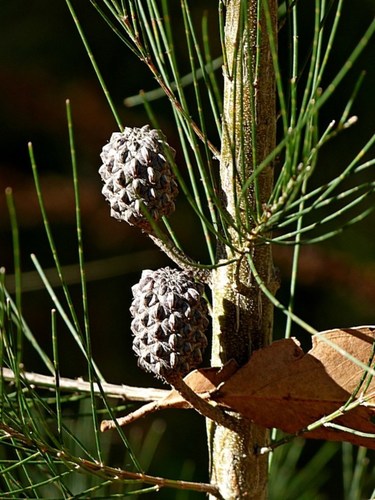
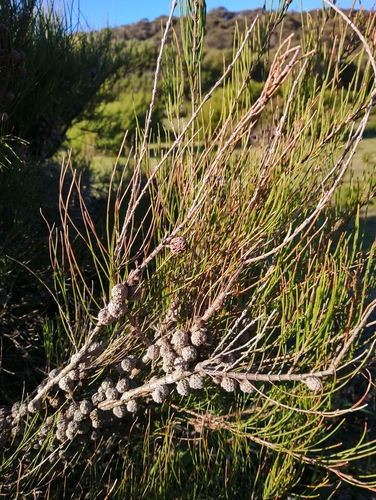
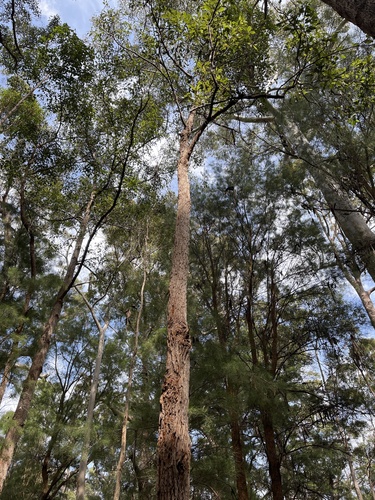
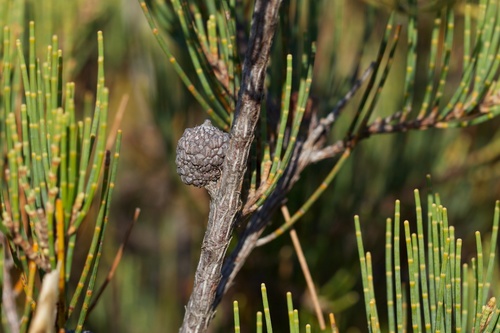
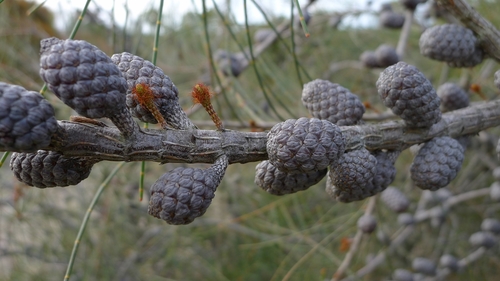
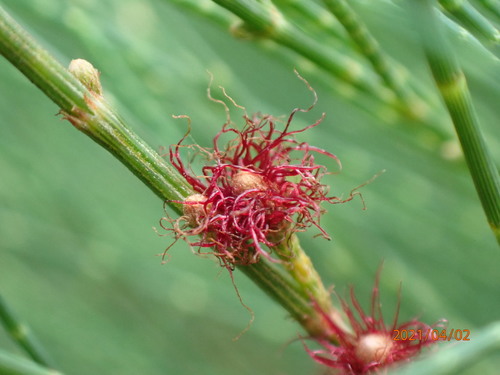
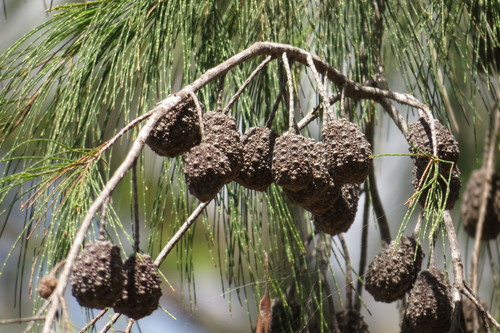
Allocasuarina torulosa is a slender, usually dioecious tree that typically reaches a height of 5–20 m (16–66 ft). It has drooping branchlets up to 140 mm (5.5 in) long; its leaves are reduced to erect, scale-like teeth 0.3–0.8 mm (0.01–0.03 in) long, arranged in whorls of four or five around the branchlets. The sections of branchlet between the leaf whorls are 5–6 mm (0.20–0.24 in) long, 0.4–0.5 mm (0.016–0.020 in) wide, and are more or less square in cross-section when young. Male flowers are arranged in spikes 5–30 mm (0.2–1 in) long, with 7 to 12 whorls per cm (per 0.4 in), and anthers measure 0.5–0.6 mm (0.020–0.024 in) long. Fruiting cones grow on a peduncle 8–30 mm (0.3–1 in) long. Mature fruiting cones (infructescences) are warty, shortly cylindrical to barrel-shaped, 15–33 mm (0.6–1 in) long, and 12–25 mm (0.5–1 in) in diameter. They contain brown, winged seeds (samaras) that are 7–10 mm (0.3–0.4 in) long. This species grows in open forest and on rainforest fringes, in moister, more nutrient-rich soils than Allocasuarina littoralis, at altitudes ranging from 40 to 1,200 m (130 to 3,940 ft). It is widespread in north-eastern and central-eastern Queensland, and on the coast and ranges of New South Wales, growing as far south as Macquarie Pass and Jenolan Caves. There is also an isolated population of A. torulosa on Cape York Peninsula. The seeds of A. torulosa are known to be a food source for the yellow-tailed black cockatoo. The timber of A. torulosa (also called rose she-oak) is reddish pink to brown. It has the largest contraction along the grain (12%) of any Australian wood, so it needs careful drying to reach its full value as a useful timber. In horticulture, A. torulosa grows from seed, and cut or broken trees will often regenerate from the trunk. It is a low-maintenance tree that grows in a variety of soils and tolerates light frosts. In the United States of America, it is suitable for USDA hardiness zones 8–11. It may be susceptible to Armillaria and Phytophthora.