About Allocasuarina luehmannii (R.T.Baker) L.A.S.Johnson
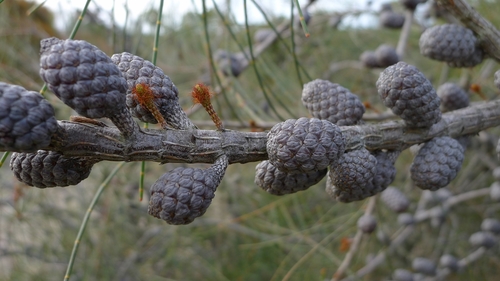
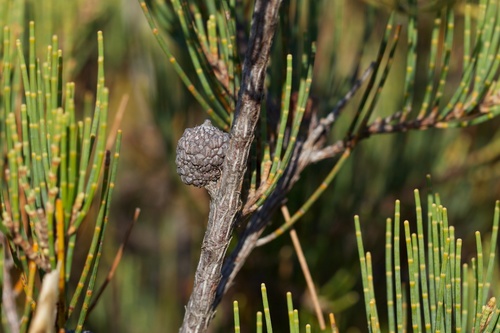
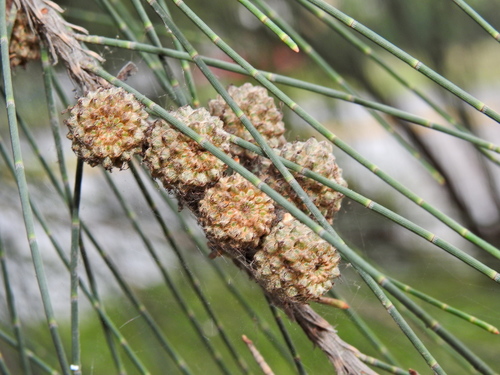
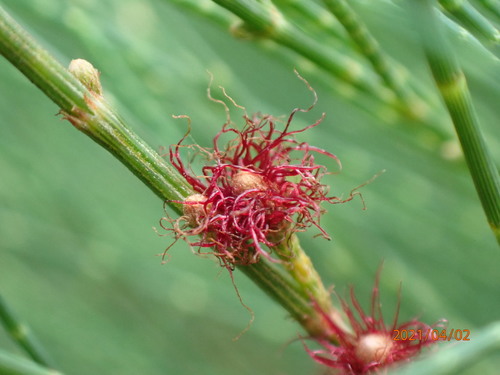
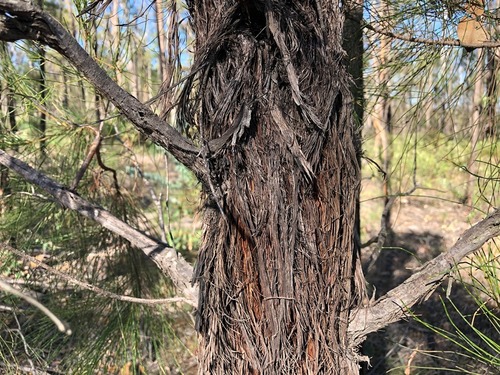
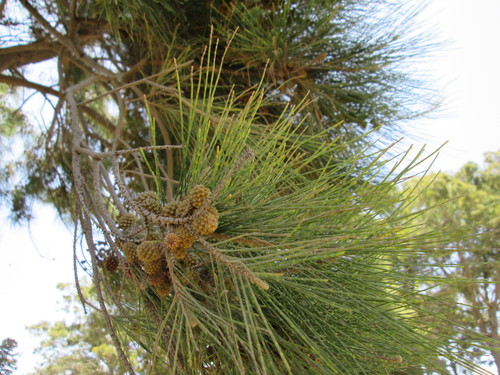
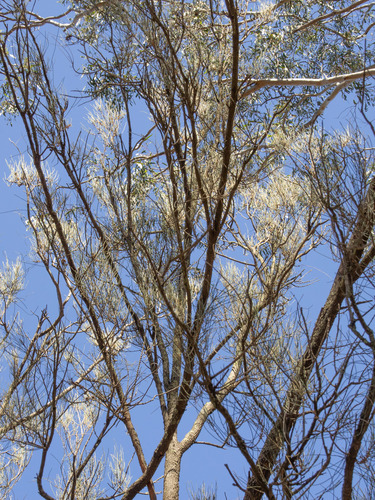
Allocasuarina luehmannii is a dioecious tree that typically reaches a height of 5–15 m (16–49 ft) and has furrowed bark. Its branchlets are more or less erect, growing up to 400 mm (16 in) long. The leaves of this species are reduced to scale-like teeth 0.5–1 mm (0.02–0.04 in) long, arranged in whorls of ten to fourteen around the branchlets. The sections of branchlet between leaf whorls, called "articles", are 8–22 mm (0.3–0.9 in) long, 1–2 mm (0.04–0.08 in) wide, and often covered in a waxy coating. Male flowers are arranged in spikes 50–105 mm (2–4 in) long, with five to eight flowers per cm (per 0.4 in), and anthers that measure 1.0–1.3 mm (0.04–0.05 in) long. Female cones are either sessile or borne on a peduncle up to 5 mm (0.2 in) long. Mature cones are shortly cylindrical, 5–12 mm (0.2–0.5 in) long and 8–14 mm (0.3–0.6 in) in diameter, and contain reddish-brown winged seeds (samaras) 4–5 mm (0.16–0.20 in) long.
In terms of distribution and habitat, Allocasuarina luehmannii usually grows in scattered locations in woodland. Its range extends from Mareeba, south through central Queensland, New South Wales and the Australian Capital Territory, to north-western Victoria and adjacent areas of South Australia. It rarely grows near the coast, with the only exceptions being the Hunter Valley and areas near Rockhampton.
Ecologically, this tree is an important food source for the endangered southeastern subspecies of the red-tailed black cockatoo in the Wimmera region of western Victoria. In this area, some remaining stands of the tree are threatened by farming practices.
The Wiradjuri people of New South Wales use the tree's timber and resinous sap to make a range of tools and other implements, including weapons such as boomerangs and clubs. Wiradjuri people also value this species because it attracts many animals that serve as food sources, including possums and birds. The Shire of Buloke in Victoria, Australia is named after this tree species.