About Allocasuarina littoralis (Salisb.) L.A.S.Johnson
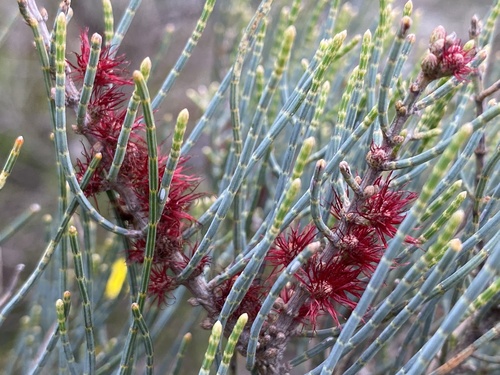
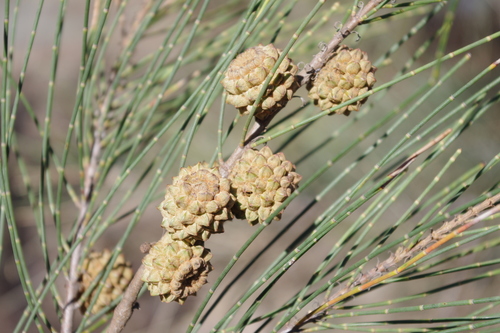
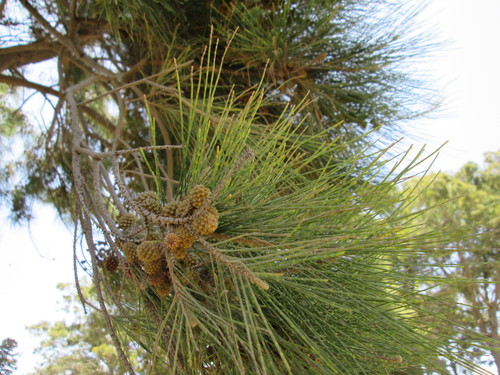
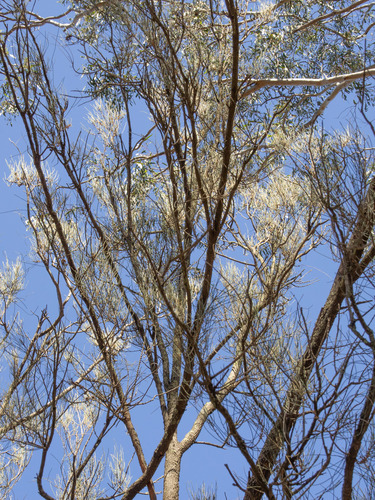
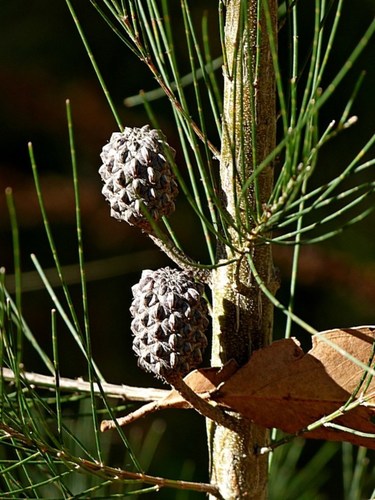
Allocasuarina littoralis is most often dioecious, and less commonly monoecious, growing as either a tree or shrub that typically reaches 5 to 15 meters (16 to 49 feet) in height. Its branchlets usually grow up to 200 mm (7.9 in) long, and rarely reach 350 mm (14 in). The true leaves of this species are reduced to small, scale-like teeth, 0.3 to 0.9 mm (0.01 to 0.04 in) long. These scale leaves are arranged in whorls, most often containing six to eight teeth, around the branchlets. The sections of branchlet between each leaf whorl, called "articles," measure 4 to 10 mm (0.2 to 0.4 in) long and 0.4 to 1.0 mm (0.02 to 0.04 in) wide. Male flowers are arranged in spikes 5 to 50 mm (0.2 to 2 in) long, with 6 to 12 whorls of flowers per centimeter (0.4 in), and anthers 0.4 to 0.8 mm (0.02 to 0.03 in) long. Female cones form on a stalk called a peduncle 4 to 23 mm (0.2 to 0.9 in) long. When mature, the cones are cylindrical, measuring 10 to 30 mm (0.4 to 1 in) long and 8 to 21 mm (0.3 to 0.8 in) in diameter. The cones contain dark brown to black winged seeds called samaras, which are 4 to 10 mm (0.2 to 0.4 in) long. This species grows primarily in sandy soil within woodland located in near-coastal areas and adjacent tablelands. It may also sometimes grow in heavy clay soils, among rocky outcrops, and occasionally occurs in tall heath. It is distributed along eastern Australia, ranging from Cape York in far north Queensland, through New South Wales, the Australian Capital Territory and Victoria, to the east coast of Tasmania, extending as far south as Hobart.