About Allocasuarina inophloia (F.Muell. & F.M.Bailey) L.A.S.Johnson
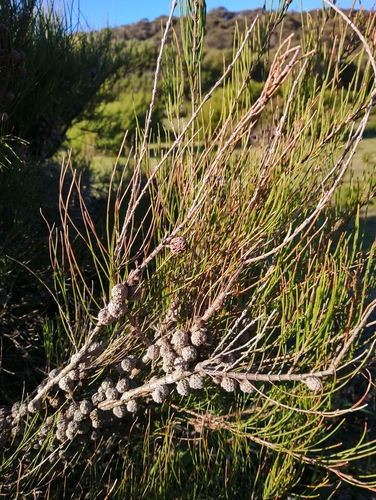
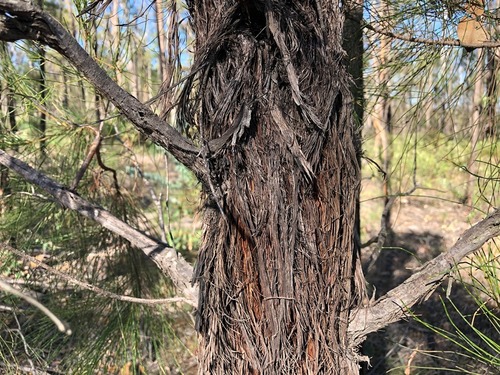
Allocasuarina inophloia is a dioecious tree with distinctive finely fibrous, ribbony bark, and typically reaches a height of 3 to 10 meters (9.8 to 32.8 feet). Its branchlets grow up to 210 millimeters (8.3 inches) long. The true leaves of this species are reduced to small, scale-like teeth that are 0.3 to 0.5 millimeters (0.01 to 0.02 inches) long, arranged in whorls of seven to nine around the branchlets. The sections of branchlet between these leaf whorls, called "articles", measure 4 to 7 millimeters (0.2 to 0.3 inches) long and 0.5 to 0.6 millimeters (0.020 to 0.024 inches) wide.
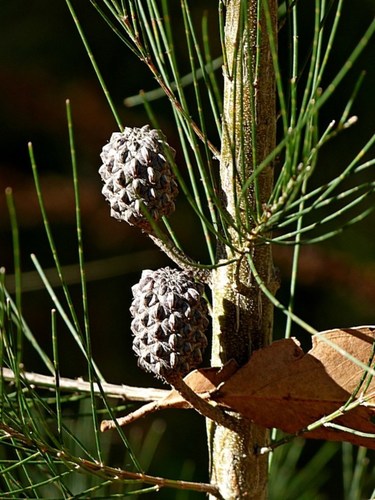
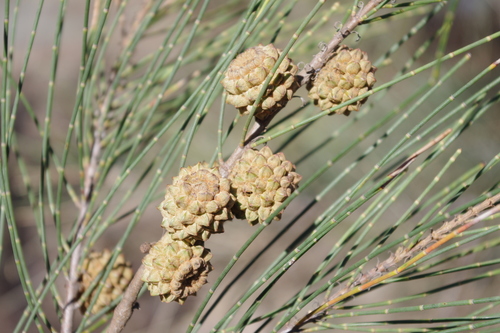
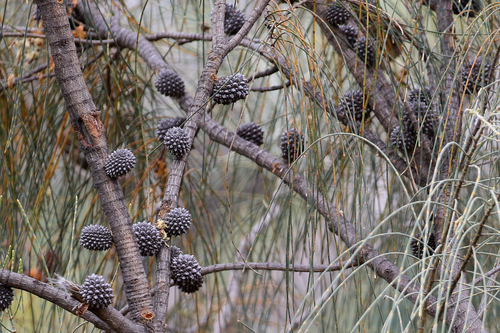
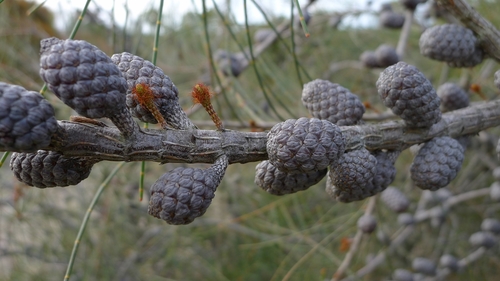
Male flowers are arranged in spikes 20 to 40 millimeters (0.8 to 2 inches) long, with 7 to 14 flowers per centimeter (per 0.4 inch) of spike, and anthers 0.5 to 0.8 millimeters (0.02 to 0.03 inches) long. Mature cones of this species are 10 to 20 millimeters (0.4 to 0.8 inches) long and 9 to 12 millimeters (0.4 to 0.5 inches) in diameter. These cones contain dark brown samaras that are 5 to 6 millimeters (0.20 to 0.24 inches) long.
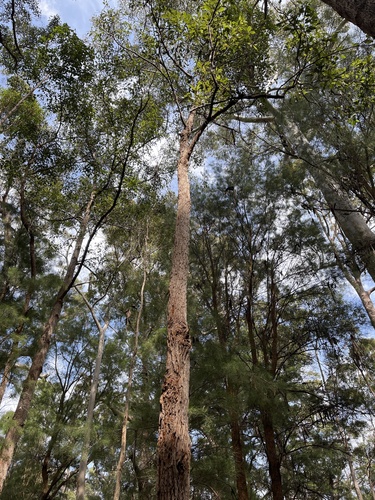
This species grows in woodland on sandstone, ironstone, or laterite ridges. It occurs from near Herberton in Queensland to Torrington and Emmaville in New South Wales, with a separated disjunct population in the Clarence River valley. In the Torrington area, it sometimes grows in tall shrubland alongside species including Allocasuarina brachystachya, Acacia williamsiana, and Micromyrtus grandis, as well as understorey shrubs like Leucopogon neoanglicus and Calytrix tetragona.
Commonly called stringybark she-oak, this plant has been recorded as a host for the orange mistletoe Dendrophthoe glabrescens. It has horticultural potential thanks to its attractive shaggy bark. It is frost hardy and can tolerate growing in poor soils.