About Allocasuarina humilis (Otto & A.Dietr.) L.A.S.Johnson
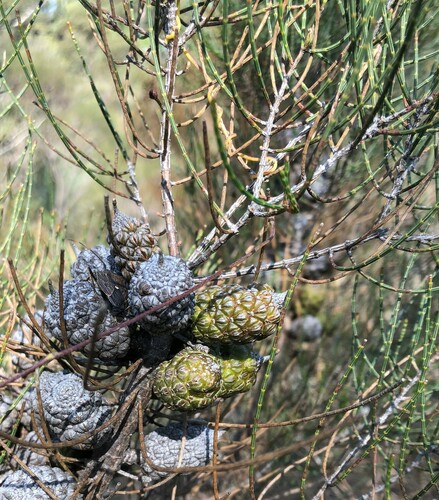
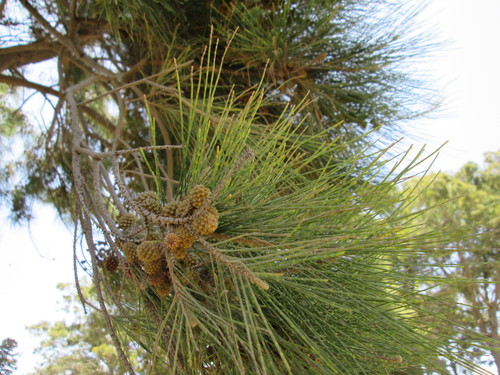
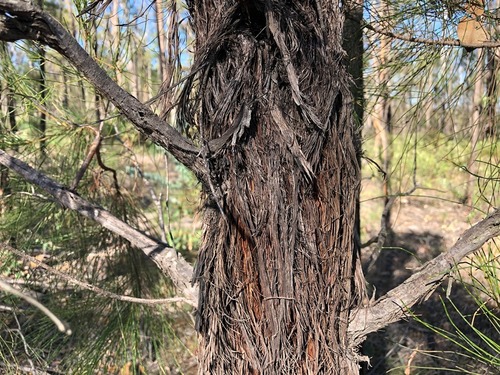
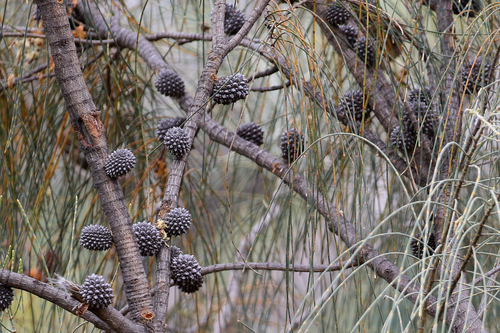
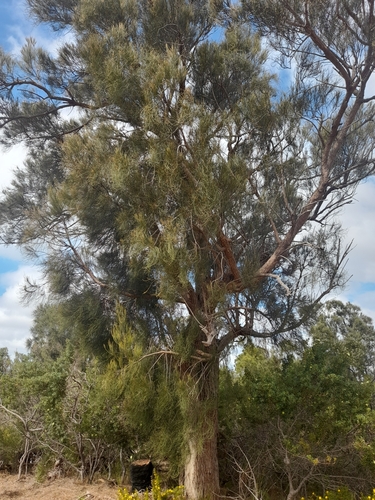
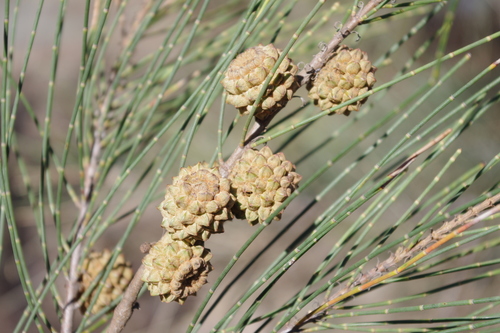
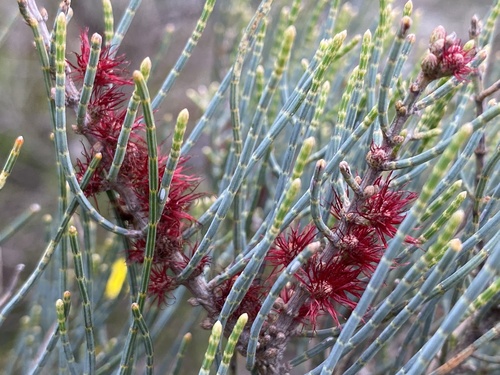
Allocasuarina humilis is an erect or spreading shrub that can be either dioecious or monoecious, and typically grows to a height of 0.2–2 m (7.9 in – 6 ft 6.7 in). It has more or less erect, needle-like branchlets that reach up to 120 mm (4.7 in) long. Its leaves are reduced to scale-like teeth 0.4–0.5 mm (0.016–0.020 in) long, arranged in whorls of five to seven around the branchlets. The branchlets are smooth and sometimes covered in a waxy coating. The sections of branchlet between the leaf whorls, called "articles", are mostly 3–6 mm (0.12–0.24 in) long and 0.8–1.2 mm (0.031–0.047 in) wide. Male flowers are arranged in spikes 6–18 mm (0.24–0.71 in) long, with 12 to 16 flowers per centimetre (per 0.39 in), and anthers 0.7–0.8 mm (0.028–0.031 in) long. Flowering occurs from May to November. Mature cones are sessile, 12–22 mm (0.47–0.87 in) long and 10–17 mm (0.39–0.67 in) in diameter. The cones contain samaras 5–6 mm (0.20–0.24 in) long that have a short wing. This species is found across southwest Western Australia, ranging from the Murchison River in the north to the south coast, and extends eastwards to Israelite Bay. It grows in sand, sand over laterite, gravel, or clay. Allocasuarina humilis adapts easily to cultivation. It is a versatile plant that tolerates a wide range of soils, including soils with some alkalinity, and prefers growing in a sunny position. It tolerates limited exposure to coastal conditions, and is planted for erosion control and as a windbreak. Unlike many Australian native plants, it is relatively tolerant of some level of phosphates when grown in cultivation.