About Allocasuarina decussata (Benth.) L.A.S.Johnson
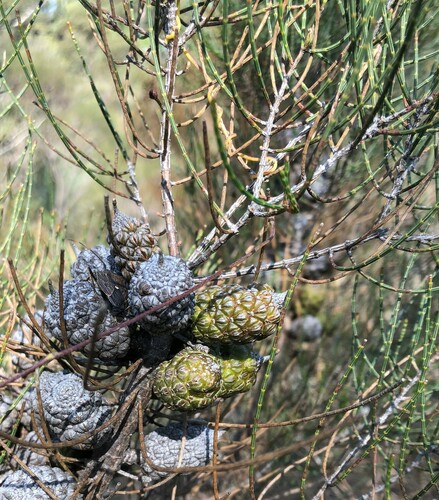
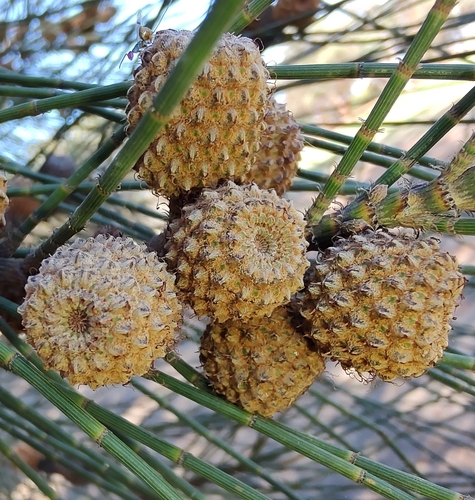
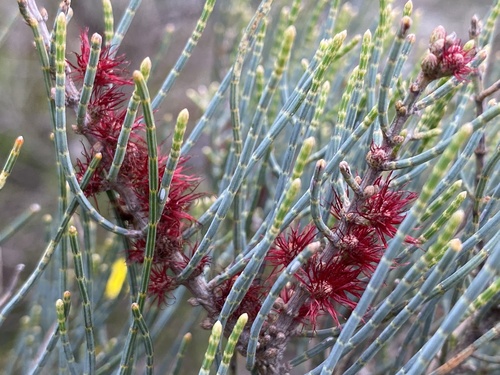
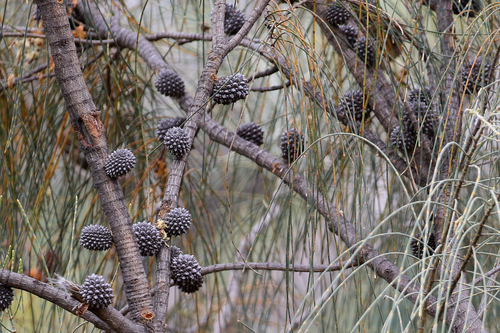
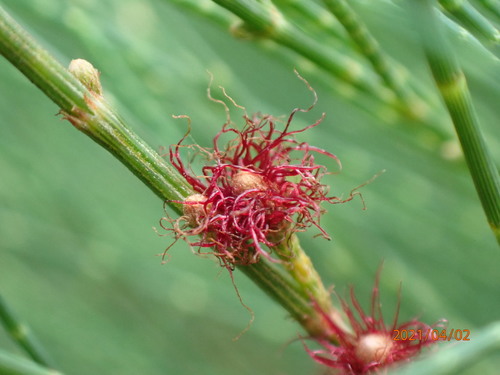
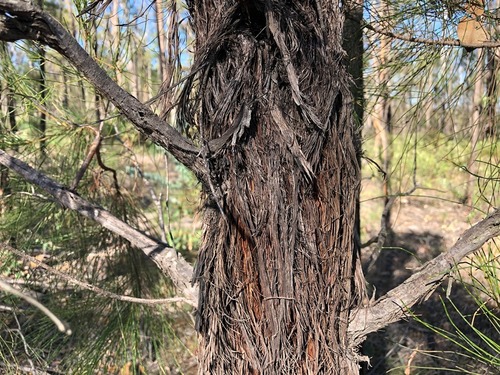
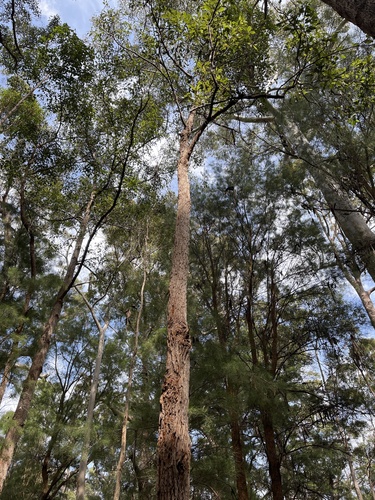
Allocasuarina decussata, commonly known as karri oak, most often grows as a medium-sized tree reaching 8 to 15 metres (26 to 49 feet) in height. However, in harsh, exposed locations such as the summit of Bluff Knoll, it grows as a stunted shrub or poorly-formed tree within shrubland. Like other species in the family Casuarinaceae, its foliage is made up of wiry green branchlets called cladodes, which bear rings of extremely small scale-like leaves. For this species, the branchlets reach approximately 140 millimetres (5.5 inches) in length, and have a roughly square or X-shaped cross section, with four scale-teeth in each ring of scales. The rings of scale-leaves are spaced 7 to 9 millimetres (0.3 to 0.4 inches) apart. Separate male and female flowers develop on the same individual plant. The fruiting structure is a woody cone, shaped as a short cylinder, with a diameter that is roughly equal to or slightly larger than its length. The seed is a winged samara 7 to 9 millimetres (0.3 to 0.4 inches) long. Karri oak very often grows in association with Acacia pentadenia, and the fern Asplenium aethiopicum frequently grows as an epiphyte on its branches. Karri oak is restricted to the southwest of Western Australia, occurring within the Esperance Plains, Jarrah Forest and Warren biogeographical regions. It grows on loam soils within karri forest, but can also be found growing on much poorer quality soils in the Stirling Range. Karri oak is not known to be in cultivation, and only limited amounts of its timber are available, because most of its populations are located within national parks. Its pale reddish-brown heartwood has distinctive rays, which means it could potentially be useful as a wood for craft purposes.