About Allocasuarina decaisneana (F.Muell.) L.A.S.Johnson
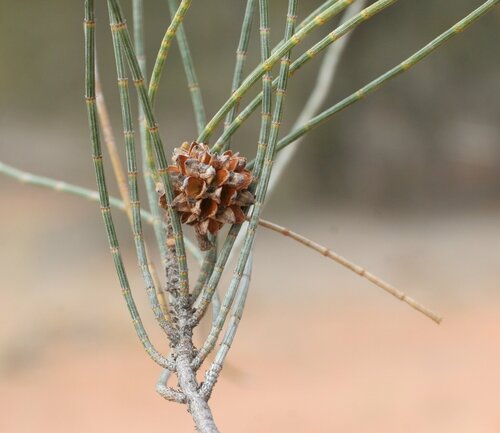
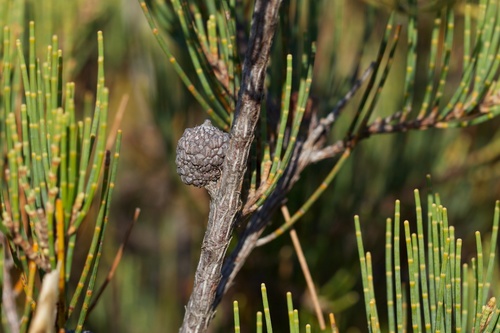
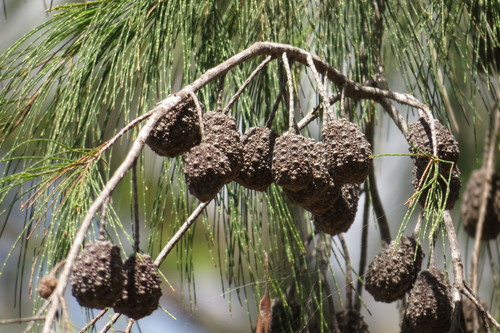
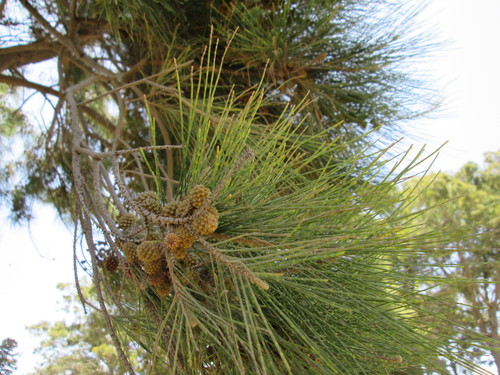
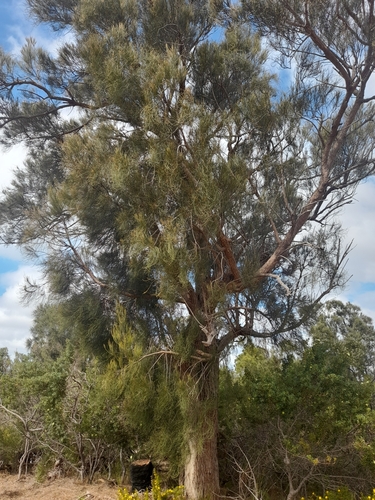
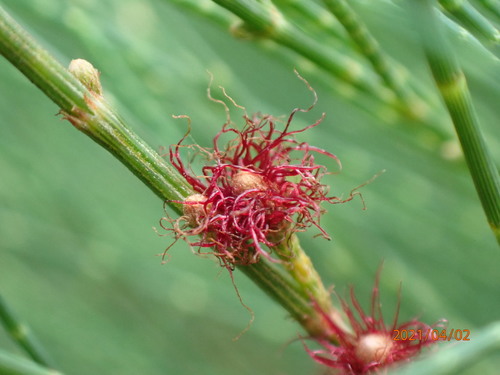
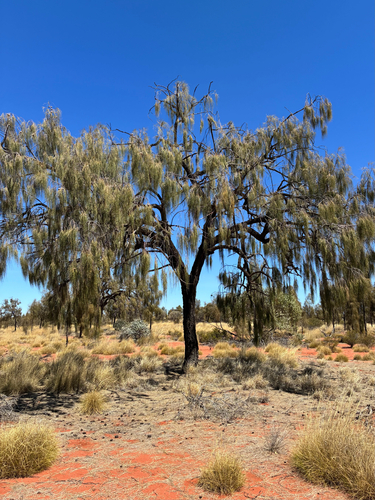
Allocasuarina decaisneana is a dioecious tree that typically reaches 10–16 m (33–52 ft) in height and 3–8 m (9.8–26.2 ft) in width. Mature specimens have a trunk covered in deeply furrowed, corky bark. The tree has drooping branchlets that grow up to 500 mm (20 in) long. Its true leaves are reduced to erect, sharply pointed teeth 1.7–3.2 mm (0.07–0.1 in) long, arranged in whorls of four around the branchlets. The sections of branchlet between leaf whorls, called "articles", are 20–60 mm (0.8–2.4 in) long and 0.7–1.5 mm (0.03–0.06 in) wide. Male flowers form spikes 20–40 mm (0.8–1.6 in) long, arranged in whorls of roughly ten per centimetre (per 0.4 in), with anthers 0.8 mm (0.03 in) long. Female cones are cylindrical, often covered in soft hair when young, and become hairless (glabrous) at maturity. They grow on a 5–15 mm (0.2–0.6 in) long stalk called a peduncle. Mature cones measure 28–95 mm (1.1–3.7 in) long and 20–35 mm (0.8–1.4 in) in diameter, with a pointed tip on the bracteoles. These are the largest cones produced by any species in the genus Allocasuarina. The tree's samaras (winged seeds) are 8.5–17 mm (0.3–0.7 in) long. Flowering occurs in most months, and cones remain present on the tree year-round. This species, commonly called desert oak, mainly grows in the swales between sand dunes on red sand. It occurs primarily in the arid lands of the southern Northern Territory, and is also common in inland Western Australia from east of Billiluna to the Mann and Musgrave Ranges in far north-western South Australia. It is the only native member of its family that occurs in these areas; the only other member of the family present is the introduced Casuarina glauca found in some locations. The flattened, leaf-like branchlets of A. decaisneana are called cladodes, and they carry out the same photosynthetic function as typical leaves while helping the tree conserve moisture. When cladodes are shed from the tree, they form a dense mat around the tree's base that prevents other plants from establishing and competing for water and nutrients. The tree's roots have nodules that host nitrogen-fixing bacteria, which lets it survive in sandy, low-nutrient soils. In its first few years of growth, this slow-growing tree develops a fast-growing taproot that can reach over 10 metres (33 ft) deep to access subsurface water. Indigenous Australian peoples used this tree as a source of water. Water could be collected from hollows in the tree, and sections of surface roots could be broken off to provide drinking water by draining the root when held vertically or by sucking water directly from the root. Indigenous peoples also used the tree's hard wood for firewood, and to make weapons and other tools, and used its seeds as food. A 10,000 year-old boomerang made from Allocasuarina decaisneana wood was discovered in Wyrie Swamp, near Millicent, South Australia.