About Alloberberis trifoliolata (Moric.) C.C.Yu & K.F.Chung
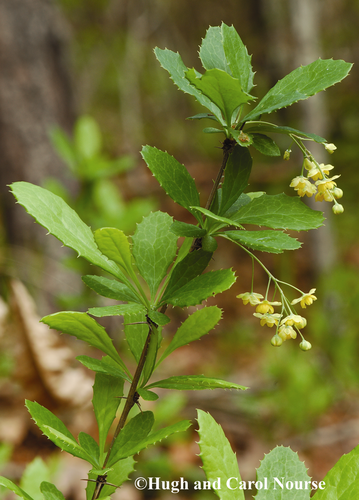
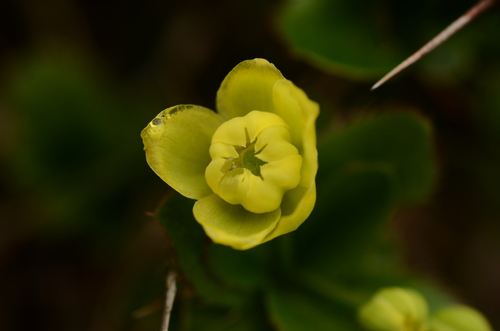
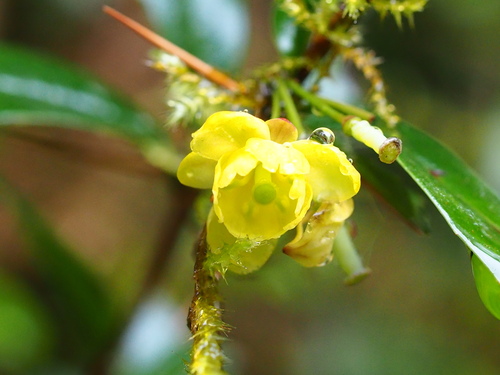
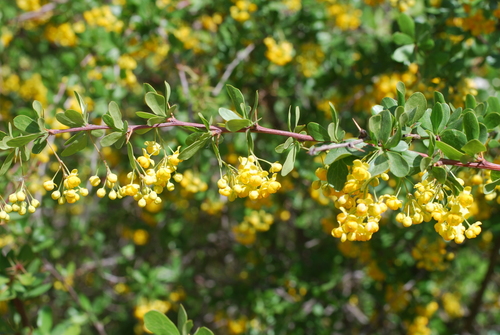
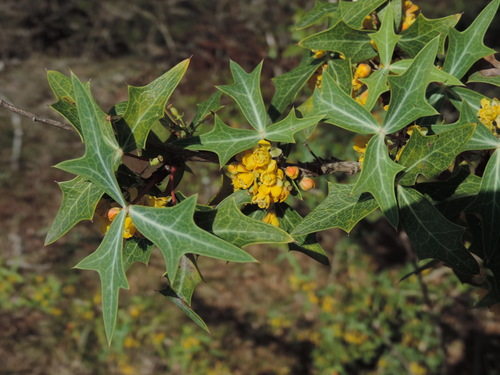
Alloberberis trifoliolata, previously classified as Berberis trifoliolata and commonly called agarita, is an evergreen shrub that reaches 1–2.5 m (3–8 ft) in both height and width. It grows rigid, spreading branches and often forms thickets. Its foliage ranges from gray-green to blue-gray, and each leaflet ends in a sharp point. This species is native to Arizona, New Mexico, and Texas in the Southwestern United States, and extends across northeastern Mexico as far south as Durango and San Luis Potosí. It occurs primarily across its native range, with no cultivation in other countries. In Texas, it grows on rocky slopes, cliffs, in thickets, and in open woods, ranging from coastal South Texas northwest to the Trans-Pecos region. It is one of the most common shrubs in Texas Hill Country, with an overall coverage of up to 300,000 hectares (730,000 acres) in the state. Due to its rapid spread, it is commonly considered a pest in Texas, with particularly large coverage found on the Edwards Plateau. Both mechanical and chemical control efforts have been attempted, but few economically viable results have been achieved, as agarita recovers quickly and is resistant to many herbicides. There are no ethnographic records of use for this species, though records do note that Plains Native Americans used Berberis haematocarpa and Berberis repens; virtually every part of those related species has been used for food, medicine, and dye historically. Agarita is well adapted to hot temperatures and dry conditions. In its native range, birds eat its fruits, and small animals use the shrub for cover. It is also a good nectar source for honey bees and other insects. Its tough, spiny trifoliate leaves are not eaten by cattle or deer. The bright red edible fruits of agarita can be harvested from late April to early May. The fruits produce slightly sweet and sour juice that can be drunk straight or made into agarita wine. The berries are also used to make jelly, pie, or cobblers; their tart flavor is reported to be pleasant when eaten with sugar. Fruits contain seeds that can be used to germinate new plants, or roasted as a coffee alternative. However, their high number of seeds makes raw consumption difficult. Native American tribes including the Apache, Chiricahua, and Mescalero used fresh and preserved fruit for food, and wood shavings as a traditional eye medicine and yellow dye for hides. During early North American pioneering years, the alkaloid berberine found in agarita roots was used to make a yellow dye. The species also has a history of medicinal use, driven by the alkaloids contained in its roots. Historically it has been used to treat ailments ranging from fevers to stomach troubles and open wounds. The Ramah Navajo and other native groups of the Pacific Northwest used it as a laxative. The roots are known to have antiseptic properties, and are used to treat wounds, skin issues, and gum problems. Alloberberis trifoliolata is cultivated as an ornamental plant for desert-region gardens. It is exceptionally tolerant of drought and heat, and can survive through dry periods without supplemental watering. It grows best in full sun, but can also be grown in light shade. It is not very cold tolerant, so it is especially suited to cultivation in regions with short, mild winters. This species can be grown from seed. Seeds require two to three months of cold stratification, so they can be sown in summer or autumn to germinate the following spring. As a perennial plant, it does not need to be reseeded yearly and has a very long lifespan. It tolerates a wide range of soil textures, including loam, clay, clay-loam, and gravel. It grows very well in dry, well-drained soils. It naturally occurs on soils derived from limestone parent material, and therefore tolerates alkaline soils. There are very few known insect or disease problems for agarita. Occasionally it develops leaf spots and rusts, most notably black stem rust. Black stem rust, caused by the fungus Puccinia graminis, is an agriculturally important disease that affects wheat, barley, oats, rye, and triticale. Alloberberis trifoliolata acts as an intermediate host for this fungus, so farmers have removed the shrubs to reduce disease prevalence. However, the climate where this plant grows naturally is typically too arid for commercial cereal cultivation. Because its roots contain high levels of the alkaloid berberine, they inhibit some root fungi, making the plant relatively resistant to pathogens.