About Allobates talamancae (Cope, 1875)
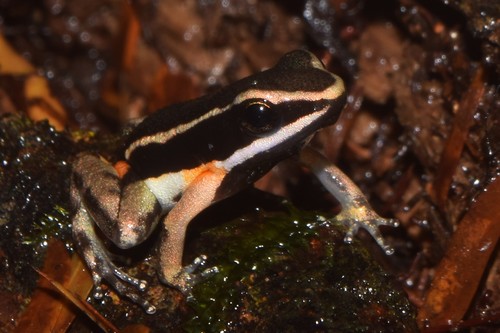
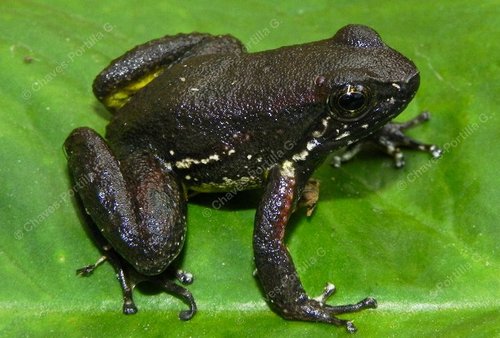
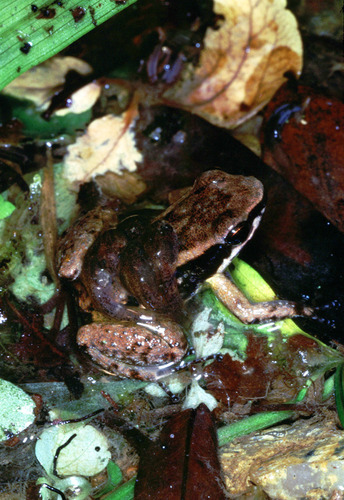
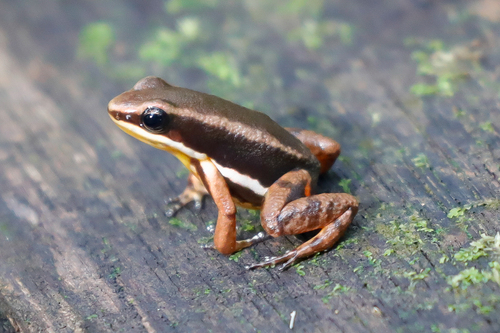
Allobates talamancae is a small non-toxic frog. Males measure 17 to 24 mm (0.67 to 0.94 inches) in snout–vent length, while females measure 16 to 25 mm (0.63 to 0.98 inches). Its dorsum is smooth and dark brown. Its flanks are black, with a tan or bronze line along the upper edge and a white line along the lower edge. Its ventrum is white, and its fingers and toes are unwebbed. This species occurs in a range of very humid lowland and premontane habitats, including secondary growth, plantations, and swampy areas within primary forest. It is not found in open areas, and usually occurs close to streams. It can be found at elevations up to 800 m (2,600 ft) above sea level, and up to 970 m (3,180 ft) in Colombia. Its diet is made up of small arthropods. Adult Allobates talamancae aggregate into small groups, a behavior that is likely an anti-predator adaptation. Although the species is common, its survival is threatened by habitat loss, the introduction of non-native predatory fish, and pollution. For reproduction, Allobates talamancae lays its eggs in leaf litter. After hatching, both parents carry the tadpoles to streams, where the tadpoles finish their development in small water-filled depressions.