About Allium tuberosum Rottler ex Spreng.
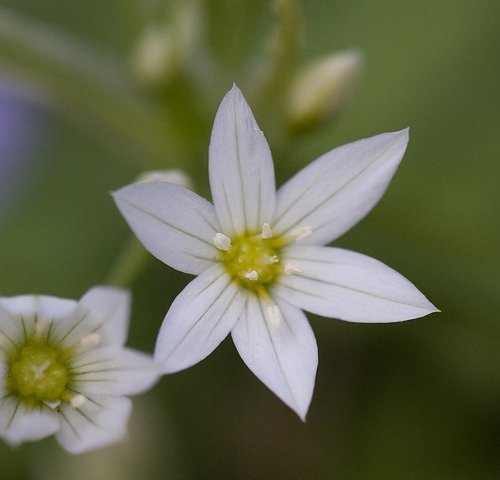
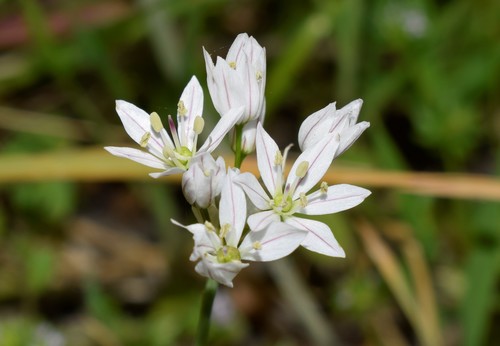
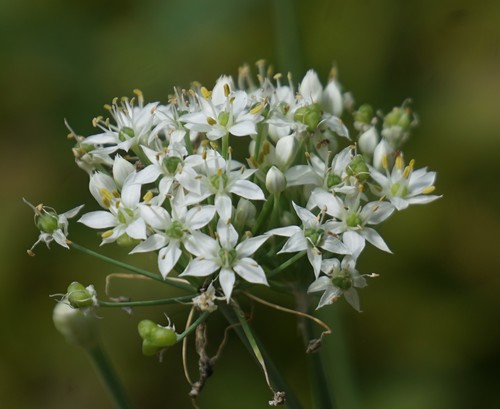
Allium tuberosum Rottler ex Spreng. is a rhizomatous, clump-forming perennial plant that grows from a small, elongated bulb around 10 mm (13⁄32 inch) across. The bulb is tough and fibrous. Unlike onions or garlic, this species has strap-shaped leaves with triangular bases that measure 1.5 to 8 mm (1⁄16 to 5⁄16 in) wide. It produces many white flowers arranged in a round umbel cluster, on stalks that grow 25 to 60 cm (10 to 24 in) tall. The plant forms slowly expanding perennial clumps, and also sprouts readily from seed. In warmer regions corresponding to USDA zone 8 and warmer, garlic chives can stay green year-round. In colder areas covering USDA zones 7 to 4b, its leaves and stalks die back completely to the ground, and resprout from the roots or rhizomes in spring. Its flavor is more similar to garlic than to chives. This species originated in the Siberian–Mongolian–North Chinese steppes, but is now widely cultivated and naturalized. It has been recorded growing wild in scattered locations across the United States, specifically in Illinois, Michigan, Ohio, Nebraska, Alabama, Iowa, Arkansas, and Wisconsin. Experts believe it is actually more widespread across North America, because seeds and seedlings of this exotic herb are easily available and the species is highly aggressive. Allium tuberosum is also widespread across most of mainland Europe, and is classified as invasive in other regions around the world. As a plant that blooms from late summer to autumn, A. tuberosum is one of several Allium species called wild onion and/or wild garlic. In many parts of the world, such as Australia, it is listed as a noxious weed or as an invasive serious high impact environmental and/or agricultural weed that spreads quickly and often forms monocultures. It is often grown as an ornamental garden plant, and multiple cultivars are available. A. tuberosum is distinct from most native or naturalized Allium species because it blooms later. It is cold-hardy to USDA zones 4–10, which corresponds to temperatures between −30 to +35 °F (−34 to 2 °C). Garlic chives are considered easy to grow in a wide range of conditions, and can spread readily via seed, or can be intentionally propagated by dividing existing clumps. Several varieties have been developed to produce improved leaves, such as 'Shiva', or improved flower stems, such as 'Nien Hua'. In Asia, cultivation of this plant has focused primarily on its culinary uses, while in North America most interest is in growing it as an ornamental. 'Monstrosum' is a giant ornamental cultivar of the species. Its uses include cultivation as an ornamental plant, including use for cut and dried flowers, and use as a culinary herb. Garlic chives have been widely cultivated for centuries across East Asia for their culinary uses. The flat leaves, stalks, and immature unopened flower buds are used as flavoring. A blanched form is also produced by regrowing the plant after cutting it while kept covered; this produces white-yellow leaves and a subtler flavor.