About Allium schoenoprasum L.
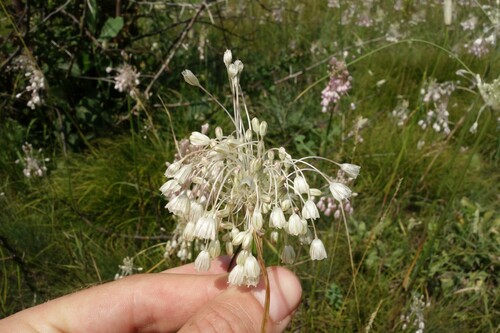
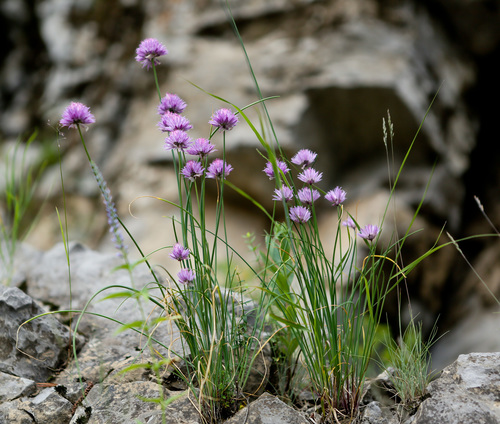
Allium schoenoprasum L., commonly known as chives, is a bulb-forming herbaceous perennial plant that grows to 25 centimetres (10 in) tall. Its bulbs are slender and conical, measuring 2–3 cm (3⁄4–1+1⁄4 in) long and 1 cm (1⁄2 in) broad, and grow in dense clusters from the roots. The scapes, or stems, are hollow and tubular, reaching up to 50 cm (20 in) long and 2–3 mm (1⁄16–1⁄8 in) across, with a soft texture that may appear stiffer than usual before a flower emerges. The grass-like leaves, which are shorter than the scapes, are also hollow and tubular, or terete, meaning round in cross-section. The pale purple, star-shaped flowers each have six petals, measure 1–2 cm (1⁄2–3⁄4 in) wide, and are produced in a dense inflorescence holding 10 to 30 flowers; before opening, the inflorescence is surrounded by a papery bract. Seeds form in a small, three-valved capsule and mature in summer. Chives flower from April to May in the southern parts of their habitat zones, and in June in the northern parts. Some specimens found in North America are classified as A. schoenoprasum var. sibiricum, though this classification is disputed. Differences between specimens are significant; one example collected in northern Maine grew solitary rather than in clumps, and bore dingy grey flowers. Chives are native to temperate areas of Europe, Asia, and North America, and are the only Allium species native to both the New World and the Old World, with a wide natural range across much of the Northern Hemisphere. In Asia, they are native from the Ural Mountains in Russia to Kamchatka in the Russian Far East. They grow natively on the Korean peninsula, and only on the islands of Hokkaido and Honshu in Japan. Their natural range in China only extends to Xinjiang and Inner Mongolia, and they are also found in adjacent Mongolia. They are native to all nations of the Caucasus, but in Central Asia they are only found in Kazakhstan and Kyrgyzstan. To the south, their range extends to Afghanistan, Iran, Iraq, Pakistan, and the Western Himalayas in India. They are native to all parts of Europe with the exception of Sicily, Sardinia, the island of Cyprus, Iceland, Crimea, Hungary, and other offshore islands. They are not native to Belgium and Ireland, but grow there as an introduced plant. In North America, they are native to Alaska and almost every province of Canada, but have been introduced to the island of Newfoundland. In the United States, the confirmed native range in the lower 48 states covers two separate areas. In the west, the native range includes Washington, Oregon, Idaho, Montana, Wyoming, and Colorado. In the east, the native range extends from Minnesota eastward through Wisconsin, Michigan, Ohio, Pennsylvania, and New Jersey, then northward into New York and all of New England. The Plants of the World Online database lists chives as introduced to Illinois and Maryland, and the USDA Natural Resources Conservation Service PLANTS database additionally lists chives as growing in Nevada, Utah, Missouri, and Virginia, with no information on whether they are native or introduced to these states. In other areas of the Americas, chives grow as an introduced plant in Mexico, Honduras, Costa Rica, Cuba, Jamaica, Hispaniola, Trinidad, Colombia, Bolivia, and the southern part of Argentina in Tierra del Fuego. Due to their sulfur compounds, chives are repulsive to most insects, but their flowers attract bees, and they are sometimes grown to support beneficial insect activity. The plant produces a large amount of nectar for pollinators, and was rated in the top 10 for most nectar production, measured as nectar per unit cover per year, in a United Kingdom plants survey conducted by the AgriLand project, which is supported by the UK Insect Pollinators Initiative. Chives have been cultivated in Europe since the Middle Ages, spanning from the fifth to the 15th centuries, though human use of chives dates back 5,000 years. They are cultivated both for culinary uses and for ornamental value; their violet flowers are often used in ornamental dry bouquets. Chives thrive in well-drained soil rich in organic matter, with a pH of 6–7, and full sun. They can be grown from seed and mature in summer, or early the following spring. Typically, chives need to be germinated at a temperature of 15 to 20 °C (59 to 68 °F) and kept moist. They can also be planted under a cloche or germinated indoors in cooler climates, then transplanted outdoors later. After at least four weeks, the young shoots are ready to be planted out. They are also very easily propagated by division. In cold regions, chives die back to their underground bulbs over winter, with new leaves emerging in early spring. Clumps of chives that start to look old can be cut back to about 2–5 cm. When harvesting, the needed number of stalks should be cut to the base. During the growing season, the plant continually regrows leaves, allowing for a continuous harvest. Chives are susceptible to damage by leek moth larvae, which bore into the plant's leaves or bulbs. In historical cultivation practice, Retzius described how farmers would plant chives between the rocks that make up flowerbed borders to keep garden plants free from pests such as Japanese beetles. The growing plant repels unwanted insect life, and leaf juice can be used for the same pest-repelling purpose, as well as to fight fungal infections, mildew, and scab.