About Allium cepa L.
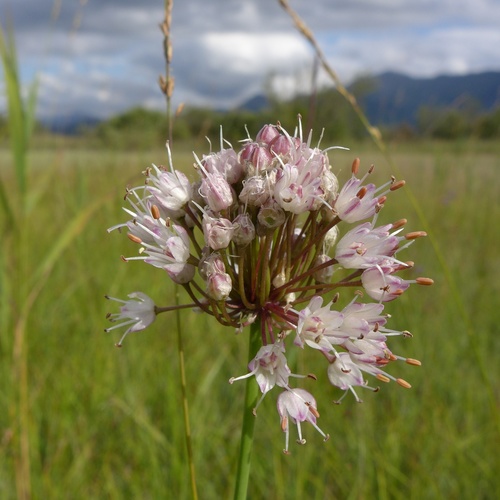
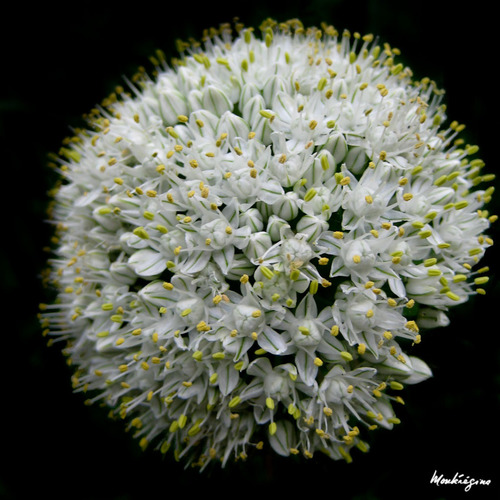
Allium cepa L., commonly known as onion, is a biennial plant that is most often grown as an annual crop. Modern varieties typically reach a height of 15 to 45 cm (6 to 18 in). Its leaves grow alternately in a flattened, fan-shaped group, and range from yellowish-green to bluish-green. The leaves are fleshy, hollow, and cylindrical, with one flattened side; they are widest around a quarter of the way up their length, and taper to blunt tips above this point. The base of each leaf is a flattened, usually white sheath that grows out of the basal plate of the onion bulb. A bundle of fibrous roots extends a short distance into the soil from the underside of this basal plate. As the onion matures, food reserves build up in the leaf bases, causing the onion bulb to swell. In autumn, the leaves die back, and the outer scales of the bulb become dry and brittle, which is when the crop is normally harvested. If left in the soil over winter, the growing point at the center of the bulb begins to develop in spring. New leaves emerge, and a long, stout, hollow stem grows, topped by a bract that protects a developing inflorescence. The inflorescence is a rounded umbel of white flowers, with floral parts arranged in groups of six. The seeds are glossy black and triangular in cross-section, and the average pH of an onion is around 5.5.
Some people experience allergic reactions after handling onions. Common symptoms include contact dermatitis, intense itching, rhinoconjunctivitis, blurred vision, bronchial asthma, sweating, and anaphylaxis. Allergic reactions often do not occur when eating cooked onions, which may be caused by protein denaturation from the cooking process.
Onions have unusually large cells that are easy to observe under low magnification. The bulb epidermis forms a single layer of cells that is simple to separate, making it useful for educational, experimental, and breeding purposes. For this reason, onions are commonly used in science education to teach how to use a microscope to observe cell structure. Boiled onion skins can also be used to make an orange-brown dye.
Onions grow best in fertile, well-drained soils. Sandy loams are ideal because they are low in sulfur, while clay-rich soils typically have high sulfur content and produce onions with pungent bulbs. Onions require a high level of nutrients in the soil. Phosphorus is often already present in sufficient quantities, but it may be applied before planting because it is not easily available in cold soils. Nitrogen and potash can be applied at regular intervals during the growing season, with the final nitrogen application done at least four weeks before harvest. Bulbing onions are sensitive to day length; their bulbs only start growing once the number of daylight hours exceeds a certain minimum quantity. Most traditional European onions are classified as "long-day" onions, which only form bulbs when there are 14 or more hours of daylight per day. Southern European and North African varieties are often "intermediate-day" types, requiring only 12 to 13 hours of daylight to stimulate bulb formation. More recently developed "short-day" onions are planted in mild-winter areas in autumn, form bulbs in early spring, and require only 11 to 12 hours of daylight to stimulate bulb formation. Onions are a cool-weather crop that can be grown in USDA zones 3 to 9. Hot temperatures or other stressful conditions cause onions to "bolt", which means a flower stem begins to grow prematurely.
Onions can be grown from seeds or from partially grown bulbs called "sets" or starter bulbs. Onion seeds are short-lived, and fresh seeds germinate better when sown in shallow rows called "drills", with each drill spaced 12 to 18 inches apart. In suitable climates, certain cultivars can be sown in late summer and autumn to overwinter in the ground and produce an early crop the following year. To grow onion sets, seeds are sown in a dense pattern in early summer, then harvested in autumn when the bulbs are still small, dried, and stored. These small bulbs are planted the following spring and grow into mature bulbs later in the growing season. Some cultivars grown for producing sets do not have as good storage quality as cultivars grown directly from seed. Routine growing season care includes keeping rows free of competing weeds, especially when the plants are young. Onions have shallow roots and do not need much water once they are established. Bulbing usually occurs 12 to 18 weeks after planting. Bulbs can be harvested as needed for fresh eating, but bulbs meant for storage are harvested after the leaves have died back naturally. In dry weather, harvested bulbs may be left on the soil surface for a few days to dry, then stored in nets, ropes, or layered in shallow boxes kept in a cool, well-ventilated place.