About Alligator mississippiensis (Daudin, 1801)
Domestic American alligators vary in body shape from long and slender to short and robust. This variation may be a response to differences in factors including growth rate, diet, and climate.
American alligators are native to both the Nearctic and Neotropical realms. In the wild, they occur in the Southeastern United States, ranging from the Lowcountry of South Carolina south to Everglades National Park in Florida, and west to South Texas. They are found in parts of North Carolina, South Carolina, Georgia, Florida, Louisiana, Alabama, Mississippi, Arkansas, Oklahoma, and Texas. Some of these locations host relatively recently introduced populations, which are often small but reproductively active. Louisiana has the largest American alligator population of any U.S. state. In the future, alligator populations may become established in areas of Mexico adjacent to the Texas border. The species' range is slowly expanding northward into areas that were once unsuitable, including Virginia. American alligators have naturally expanded their range into Tennessee, and the state's wildlife agency confirms they have established a small population in southwestern Tennessee via inland waterways. They were previously extirpated from Virginia, and occasional vagrants from North Carolina wander into the Great Dismal Swamp there. In 2021, one individual was found in Calvert County, Maryland, near Chesapeake Bay, where it was shot and killed by a hunter with a crossbow. There are additional reports of American alligators from this region, but these are thought to be escaped or released exotic pets.
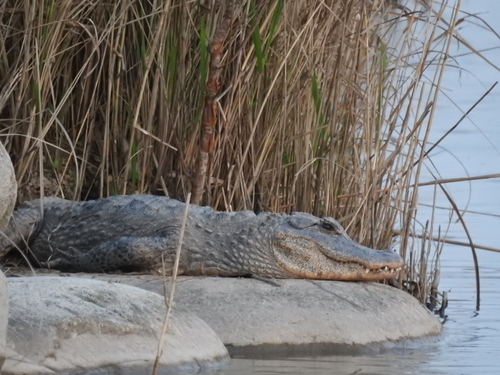
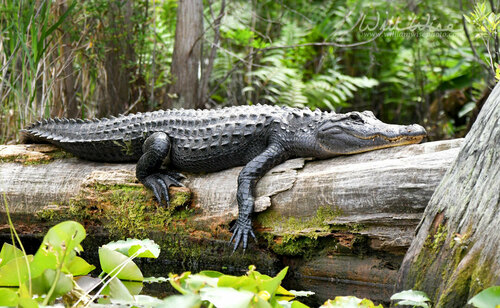
American alligators live in swamps, streams, rivers, ponds, lakes, and wetland prairies that are interspersed with shallow open water and canals with associated levees. One lone American alligator was spotted living in a river north of Atlanta, Georgia, for over 10 years. Females and juveniles are also found in Carolina Bays and other seasonal wetlands. While they prefer fresh water, they may sometimes wander into brackish water, but they are less tolerant of salt water than American crocodiles, because the salt glands on their tongues do not function. One study of American alligators in north-central Florida found that males preferred open lake water during the spring, while females used both swampy and open-water areas. During summer, males still preferred open water, while females stayed in swamps to build their nests and lay eggs. Both sexes may den under banks or clumps of trees during the winter. In some parts of their range, American alligators are an unusual example of urban wildlife; golf courses are often favored by the species because they provide abundant water and a regular supply of prey such as fish and birds.
Recent research on juvenile American alligators shows that young alligators can adjust their behavior in response to stressful environments, particularly environments with higher salt levels. Instead of adapting physically, juveniles change their daily habits such as basking in the sun or moving between habitats to avoid dehydration from salt water. As sea levels continue to rise, the ability of alligators to adapt and maintain normal body function despite changing environments is especially important.
There are documented records of American alligators using lures to hunt prey such as birds, placing them among the first reptiles recorded to use tools. By balancing sticks and branches on their heads, American alligators lure birds that are searching for nesting material, then kill and consume the birds. This hunting strategy, which is also used by mugger crocodiles, is particularly effective during the bird nesting season, when birds are more likely to collect suitable nesting materials. This behavior was documented multiple times per day during peak nesting season in two Florida zoos, and also in some parks in Louisiana. Tool use was documented mostly during peak rookery season, when birds actively search for sticks. However, a 2019 three-day experiment that attempted to reproduce the behavior of using sticks as lures failed to document the targeted pattern. Researchers placed sticks at densities of 30 to 35 sticks per square meter near four captive alligator populations: two near bird rookeries and two at sites with no rookeries. While stick-displaying behavior was observed several times, it was not more frequent near rookeries. In fact, in some comparisons it was associated with non-rookery sites. This suggests that American alligators do not adjust this behavior to specific contexts, leaving the purpose, if any, of their stick-displaying behavior ambiguous.