About Alkekengi officinarum Moench
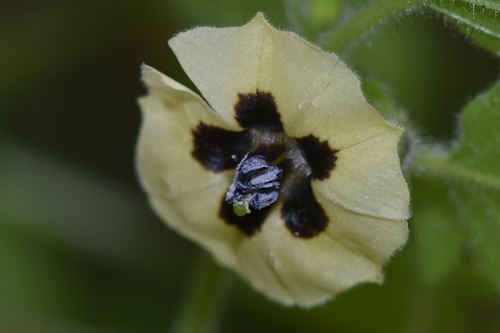
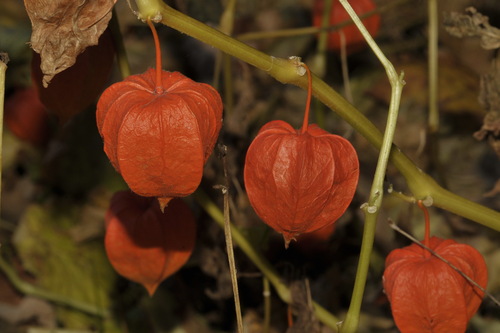
Alkekengi officinarum Moench is easily identifiable by its large, bright orange to red papery calyx that covers its fruit, a structure that resembles paper lanterns. This is a perennial herbaceous plant that grows 40–60 cm (16–24 in) tall. It produces spirally arranged leaves that are 6–12 cm (2+1⁄2–4+1⁄2 in) long and 4–9 cm (1+1⁄2–3+1⁄2 in) broad. Its flowers are white, with a five-lobed corolla 10–15 mm (3⁄8–5⁄8 in) across; they grow from an inflated basal calyx that matures into the papery orange fruit covering, which is 4–5 cm (1+1⁄2–2 in) long and broad. One recognized variety of this species is Alkekengi officinarum var. franchetii. Research has found that Calliphysalis carpenteri, which was formerly classified as Physalis carpenteri, is among the species most closely related to this plant (previously referred to as Physalis alkekengi).
It is a popular ornamental plant that is widely cultivated in temperate regions across the world. It is very hardy, tolerating temperatures below −20 °C (−4 °F). Its wide-spreading root system sends up new shoots some distance from the original planting site, which can make it invasive. It has escaped from cultivation in many locations around the world. In the United Kingdom, this plant has received the Royal Horticultural Society's Award of Garden Merit.
In the Unani system of medicine, the dried fruit of this plant is called the golden flower, and it is used as a diuretic, antiseptic, liver corrective, and sedative. In traditional Chinese medicine, Alkekengi officinarum is used to treat conditions including abscesses, coughs, fevers, and sore throats. The extinct Dacian language has left very few traces; however, Pedanius Dioscorides discusses a plant called Strychnos alikakabos (Στρύχνος άλικακάβος) in his text De Materia Medica, which the Dacians called kykolis (or cycolis). Some sources have suggested this plant is Alkekengi officinarum, but the name is more likely to refer to ashwagandha (Withania somnifera).