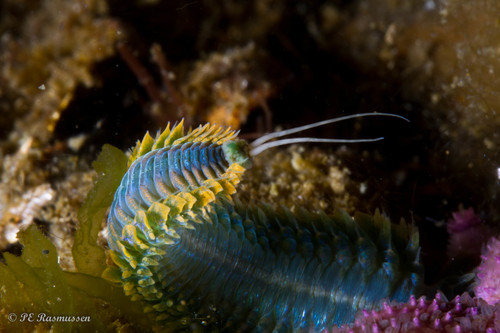
About Alitta virens (M.Sars, 1835)
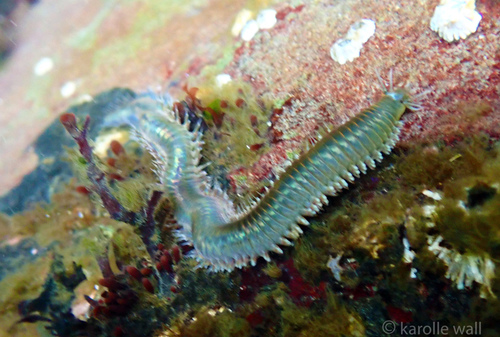
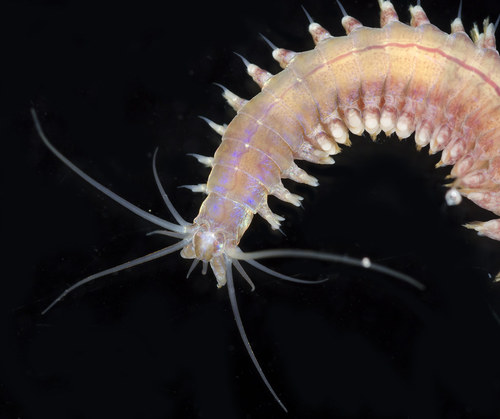
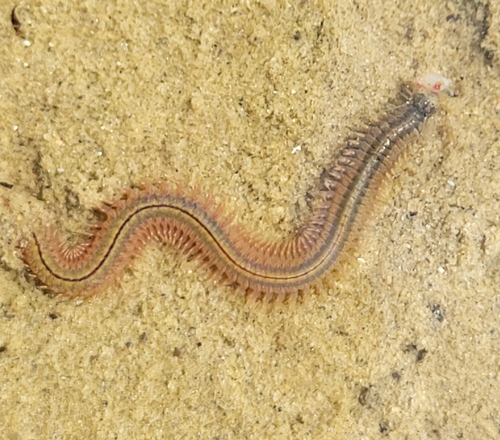
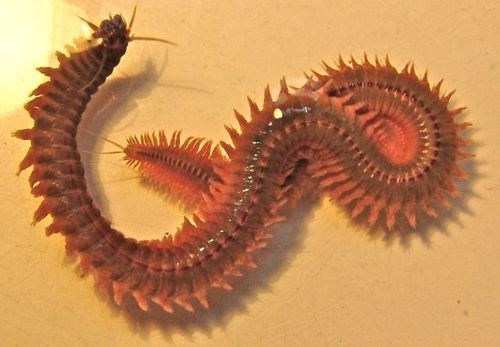
Alitta virens, commonly called sandworm, sea worm, and king ragworm, is still frequently referenced by its older scientific name Nereis virens. It is an annelid polychaete worm in the family Nereididae, first described by biologist Michael Sars in 1835. This species burrows in wet sand and mud, and builds burrows in I, U, J, and Y shapes that range from very simple to very complex. Long-term burrows are bound together with mucus. These worms are generally solitary, and their burrows are not connected to one another. The spacing between individual burrows depends on how well the worms can propagate water signals through the sediment. Alitta virens has many distinctive traits. It often reaches great lengths, sometimes exceeding four feet, with a common approximate size of around 30 cm. It has numerous, highly vascularized parapodia running along both sides of its body; these parapodia act as the worm’s primary respiratory external gills, and also function in locomotion, appearing similar to short legs. It has a blue head with two large pincer teeth capable of biting humans and other organisms. This species is abundant on European coasts and in fjord environments, dominates fully saline coastal areas, and has a large distribution alongside a large biomass. Alitta virens is omnivorous; it feeds on seaweed, microorganisms, surface sediment, and plant and animal remains. The worms are often exposed to metals through their diet and burrowing behavior, so they are an essential study organism for investigating metal uptake and evaluating metal effects on marine organisms. These worms are generally gonochoric, meaning they reproduce sexually between separate male and female individuals. They reproduce through a process called swarming: females release pheromones that attract males, which release sperm, and then females eject eggs for fertilization. Gametes are produced via the metanephridia gland. Sandworms make up a large portion of the live sea-bait industry, and some are commercially cultivated to meet industry demand. The harvesting of sandworms from mudflats, called sandworming, employs over 1,000 people in Maine, US. As of 2006, sandworm populations had decreased greatly over the preceding several years, largely due to overharvesting that occurs before the worms can spawn and reproduce.