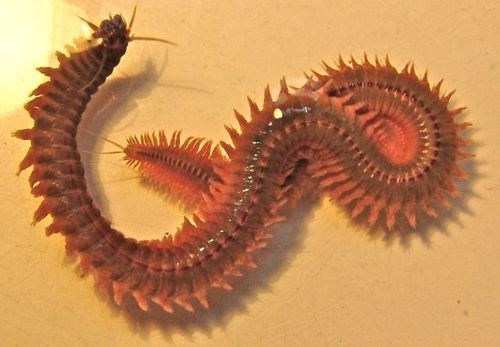
About Alitta succinea (Leuckart, 1847)
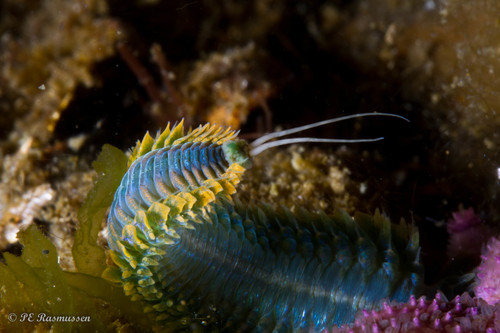
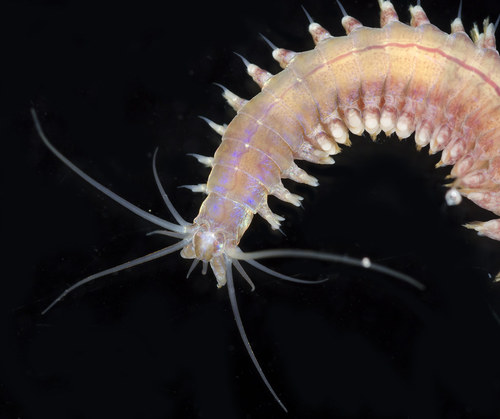
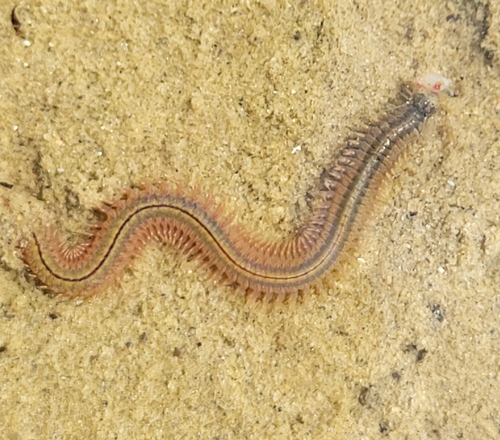
Alitta succinea, commonly known as the clam worm, has a long, elongated, cylindrical body divided into 160 segments. It has four eyes and two pear-shaped antennae at its front end, with a longer posterior body. This species can reach up to 15 centimetres (6 in) in length, though most specimens are smaller. It is brown at the rear, and reddish-brown across the rest of its body. It has a distinct identifiable head that holds four eyes, two sensory palps, and many tentacles; the head is split into two segments: the anterior and posterior prostomium. The final body segment is called the pygidium. The jaws of the clam worm are partly made of zinc, which makes them lighter than calcified jaws while still retaining full strength. To feed, the clam worm uses a proboscis with two hooks at its end to grasp prey and pull it into its mouth. Clam worms are classified as omnivorous deposit feeders, because they consume organic matter, waste, and debris from the surrounding water, alongside feeding on aquatic plants such as algae and diatoms, and other small worms. They are an important food source for bottom-feeding fish, crustaceans, crabs, and shorebirds. Populations of Alitta succinea in the Caspian Sea are heavily influenced by fish predation, and the species was intentionally introduced to the Caspian Sea to increase fish populations for commercial fishing. Alitta succinea can act as an indicator of habitat imbalance. Populations in the Black Sea have been shown to indicate changes in water chemistry, and die-offs of this species occur when their habitats experience hostile environmental changes. When clam worm populations decline, shorebird populations commonly decline as a result. Alitta succinea is a free-swimming polychaete that scavenges along the bottom of shallow marine waters. It can protect itself by secreting a mucous substance that hardens to form a protective sheath around its body. Like most polychaetes, Alitta succinea has separate sexes, and fertilization normally occurs externally. Reproduction involves the transformation of a sexually immature worm (called an apitoke) into a sexually mature worm (called an epitoke), a process known as epitoky that has two forms: schizogamy and epigamy. In schizogamy, the original organism divides into sexual and asexual parts, and asexual reproduction produces buds from its posterior end. Each bud develops into an epitoke, which breaks off from the original atoke once fully formed and becomes free-swimming. Epigamy, the other form of this transformation, involves morphological changes: both female and male worms undergo metamorphosis into epitokes that are better adapted for swimming and carry gametes. When they reach sexual maturity, transformed individuals become nektonic, free-swimming heterononeid forms: free-swimming dimorphic sexual individuals. These are similar to the non-reproductive form of the worm, but have larger, often lobal parapodia. Other modifications of the heterononeid form can include enlarged parapodia for improved swimming ability, a body cavity filled with gametes, larger eyes, and incomplete gut formation. During lunar phases in spring and early summer, Alitta succinea undergoes epigamy: their parapodia enlarge to let them swim, their body cavities fill with sex-appropriate gametes, they release eggs and sperm, and die soon after. Females produce a pheromone that attracts males and signals them to release sperm, which in turn stimulates females to release eggs; this coordinated activity is called swarming. Both sexes swim to the surface to release gametes, and swarming increases the chance of successful fertilization. Environmental factors including temperature, salinity, light levels, and the lunar cycle can trigger swarming. Reproduction normally occurs from early spring and can extend into summer. Both sexes die after swarming. After fertilization, most eggs become planktonic, though some are retained in the worm's tubes or burrows in jelly masses attached to the tubes, as the parent acts as an egg brooder. Fertilized eggs develop into planktonic trochophore larvae, which metamorphose into juveniles, then grow into adults that eventually sink to the bottom of the water.