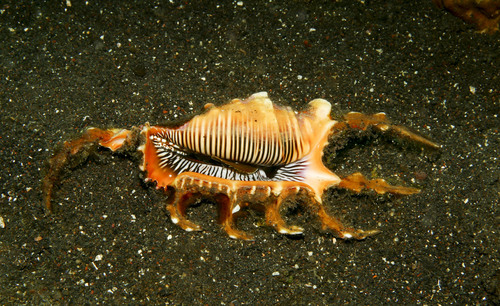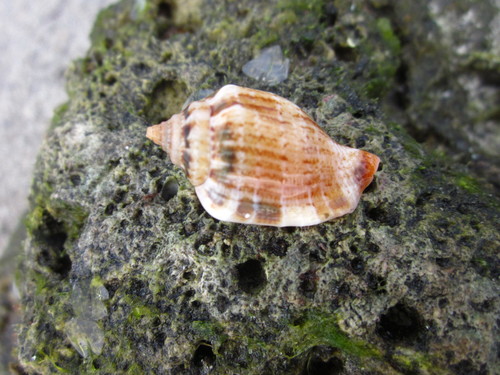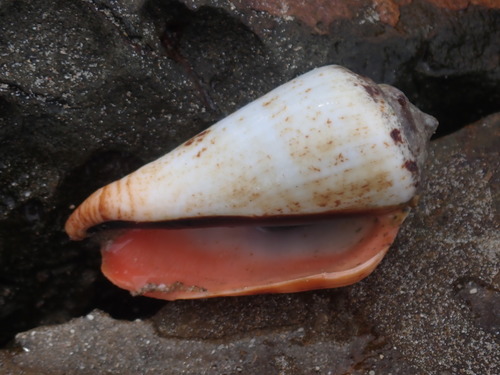
About Aliger gigas (Linnaeus, 1758)
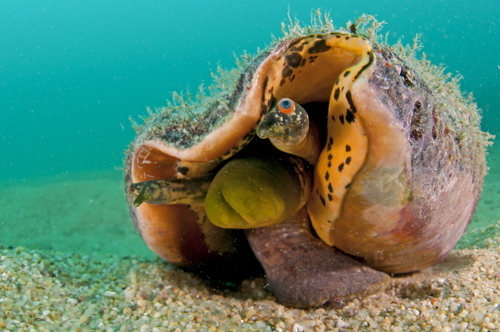
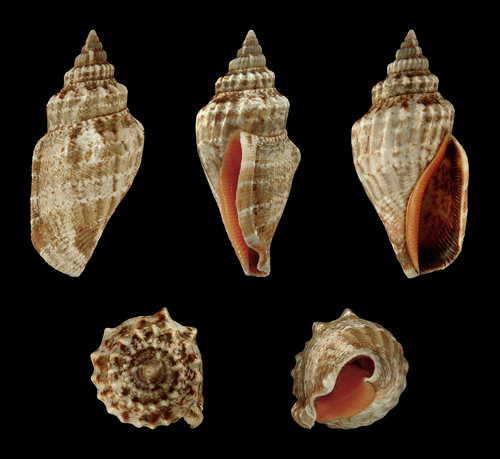
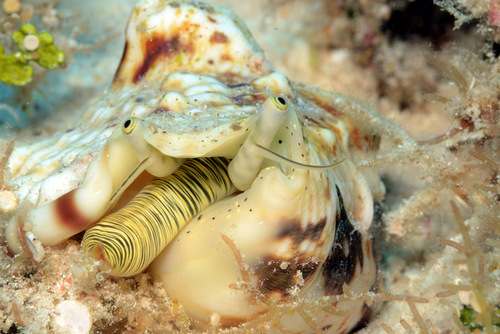
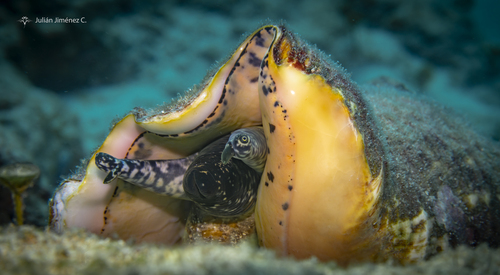
Aliger gigas, originally named Strombus gigas and more recently classified as Lobatus gigas, is commonly known as the queen conch. It is a species of large sea snail, a marine gastropod mollusc belonging to the true conch family Strombidae. This species is one of the largest molluscs native to the Caribbean Sea and tropical northwestern Atlantic, with a maximum recorded shell length of 35.2 centimetres (13.9 in). A. gigas is closely related to the goliath conch, Titanostrombus goliath, which is endemic to Brazil, and the rooster conch, Aliger gallus. The queen conch is herbivorous. It feeds by browsing for plant and algal material that grows in seagrass beds, and also scavenges decaying plant matter. These large sea snails typically live in seagrass beds, which are sandy plains covered in waving sea grass linked to coral reefs, though the species’ exact habitat changes based on developmental age. Adult queen conchs have very large, solid, heavy shells with knob-like spines on the shoulder, a flared thick outer lip, and a characteristic pink or orange aperture (opening). The outer surface of the shell is sandy colored, which helps the snail blend into its surroundings. Juvenile queen conchs do not have a flared lip; this structure only develops once the snail reaches reproductive age. The thicker the shell’s flared lip is, the older the conch is. The external anatomy of A. gigas’ soft body is similar to other strombids: it has a long snout, two eyestalks with well-developed eyes, additional sensory tentacles, a strong foot, and a corneous, sickle-shaped operculum. Living A. gigas provide a home for several types of commensal animals inside their shells and soft tissues, including slipper snails, porcelain crabs, and the specialized conchfish Astrapogon stellatus. Known parasites of this species include coccidians. Natural predators of the queen conch include several species of large predatory sea snails, octopus, starfish, crustaceans, and vertebrates such as fish, sea turtles, and nurse sharks. It is a particularly important food source for large predators like sea turtles and nurse sharks. Humans have captured and consumed queen conch since prehistory. Its shell is sold as a souvenir and used as a decorative object. Historically, Native Americans and indigenous Caribbean peoples used parts of the shell to make various tools. International trade in the Caribbean queen conch is regulated under the Convention on International Trade in Endangered Species of Wild Fauna and Flora (CITES), where it is listed under the name Strombus gigas. While the species is not endangered across the entire Caribbean region, it is commercially threatened in many areas, mostly due to severe overfishing. Aliger gigas is native to the tropical Western Atlantic coasts of North and Central America in the greater Caribbean tropical zone. Scientific literature has recorded the species occurring in these locations, though it also appears elsewhere: Aruba (Netherlands Antilles); Barbados; the Bahamas; Belize; Bermuda; the northern and northeastern regions of Brazil (this record is contested); Old Providence Island, Colombia; Costa Rica; Haiti; the Dominican Republic; Panama; Swan Islands, Honduras; Jamaica; Martinique; Alacran Reef, Campeche, Cayos Arcas, and Quintana Roo, Mexico; Puerto Rico; Saint Barthélemy; Mustique and Grenada, in the Grenadines; Pinar del Río, North Havana Province, North Matanzas, Villa Clara, Cienfuegos, Holguín, Santiago de Cuba, and Guantánamo, Cuba; the Turks and Caicos Islands; South Carolina, Florida (including the Florida Keys and Flower Garden Banks National Marine Sanctuary), the United States; Carabobo, Falcon, Gulf of Venezuela, Los Roques archipelago, Los Testigos Islands, and Sucre, Venezuela; all islands of the United States Virgin Islands. Aliger gigas lives at depths ranging from 0.3 to 18 m, and also occurs deeper to 25–35 m. Its depth range is limited by the distribution of seagrass and algae cover. In heavily fished areas, queen conchs are more abundant at the deeper end of this range. The queen conch lives in seagrass meadows and on sandy substrate, usually associated with turtle grass (genus Thalassia, specifically Thalassia testudinum, plus Syringodium sp.) and manatee grass (Cymodocea sp.). Juveniles live in shallow, inshore seagrass meadows, while adults prefer deeper algal plains and seagrass meadows. Critical nursery habitats for juvenile queen conchs have specific characteristics, including tidal circulation and macroalgal production, that together support high rates of recruitment and survival. A. gigas is typically found in distinct aggregates that can contain several thousand individuals. Aliger gigas is gonochoristic, meaning each individual is either male or female. In natural populations, females are usually larger than males, and the two sexes occur at similar proportions. After internal fertilization, females lay eggs in long gelatinous strings that can reach 23 m (75 feet) in length. These egg strings are laid over patches of bare sand or seagrass. The sticky surface of the long strings lets them coil and clump, mixing with surrounding sand to form compact egg masses. The shape of the egg mass is shaped by the anterior portion of the outer lip of the female’s shell during laying. A single egg mass may be fertilized by multiple males. The number of eggs per egg mass varies widely based on environmental conditions including food availability and temperature. Typically, females produce 8 to 9 egg masses per reproductive season, each holding 180,000 to 460,000 eggs, though counts can reach as high as 750,000 eggs per mass. A. gigas females may spawn multiple times during the reproductive season, which runs from March to October, with peak activity from July to September. Queen conch embryos hatch 3 to 5 days after spawning. When they hatch, the protoconch (embryonic shell) is translucent, with a creamy off-white background marked by small pustulate spots. This coloration differs from other Caribbean Lobatus species like Lobatus raninus and Lobatus costatus, which have unpigmented embryonic shells. After hatching, the two-lobed pelagic veliger larva, a larval form common to many marine and freshwater gastropod and bivalve molluscs, spends several days developing in the plankton, feeding mainly on phytoplankton. Metamorphosis happens 16 to 40 days after hatching, when the fully developed protoconch is about 1.2 mm high. After metamorphosis, A. gigas individuals live the rest of their lives in the benthic zone (on or within the sediment surface), and usually stay buried during their first year of life. The queen conch reaches sexual maturity around 3 to 4 years of age, when it reaches a shell length of nearly 180 mm and weighs up to 5 pounds. Individuals usually live up to 7 years, but in deeper waters their lifespan can reach 20 to 30 years, with maximum lifetime estimates reaching 40 years. Mortality rates are thought to be lower for mature conchs due to their thickened shells, but substantially higher for juveniles. Studies show that the species’ mortality rate decreases as its size increases, and can also change based on habitat, season, and other factors. Queen conch meat has been eaten for centuries, and has traditionally been an important part of the diet for many West Indian and Southern Florida islands. It is eaten raw, marinated, minced, or chopped in a wide range of dishes including salads, chowder, fritters, soups, stews, pâtés, and other local recipes. In both English and Spanish-speaking regions, such as the Dominican Republic, A. gigas meat is called lambí. While conch meat is mainly used for human consumption, it is also sometimes used as fishing bait, most often the foot. A. gigas is one of the most important fishery resources in the Caribbean: its harvest value was US$30 million in 1992, rising to $60 million in 2003. The total annual harvest of A. gigas meat ranged from 6,519,711 kg to 7,369,314 kg between 1993 and 1998, and production later dropped to 3,131,599 kg in 2001. Data on US imports shows a total of 1,832,000 kg in 1998, compared to 387,000 kg in 2009, an almost 80% reduction over twelve years. Native Americans and Caribbean indigenous peoples used queen conch shells in many ways. South Florida groups including the Tequesta, as well as the Carib, Arawak, and Taíno, used queen conch shells to make tools such as knives, axe heads, and chisels, jewelry, and cookware, and used them as blowing horns. In Mesoamerican history, the Aztecs used the shell in jewelry mosaics including the double-headed serpent. The Aztecs also believed the sound of trumpets made from queen conch shells represented divine manifestations, and used these trumpets in religious ceremonies. In central Mexico, during rain ceremonies dedicated to the god Tlaloc, the Maya used conch shells as hand protectors similar to boxing gloves during ritual combat. Ancient middens of L. gigas shells with round holes are taken as evidence that pre-Columbian Lucayan Indians in the Bahamas used the queen conch as a food source. After being brought to Europe by explorers, queen conch shells quickly became a popular commodity in early modern Europe. In the late 17th century, they were widely used as decoration on fireplace mantels and in English gardens, among other locations. In contemporary times, queen conch shells are mainly used in handicrafts. Shells are made into cameos, bracelets, and lamps, and have traditionally been used as doorstops or decorations by seafaring families. The shell remains popular as a decorative object, though its export is now regulated and restricted by the CITES agreement. In modern culture, queen conch shells are often depicted on everyday items including coins and stamps. Very rarely, around 1 in 10,000 conchs, a conch pearl may form inside the mantle. These pearls come in a range of colors matching the interior of the queen conch shell, and pink specimens are the most valuable. Conch pearls are considered semi-precious, and are a popular tourist curio. The best specimens have been used to make necklaces and earrings. A conch pearl is a non-nacreous pearl (previously called a “calcareous concretion” by some sources); unlike most gemstone pearls, it is not iridescent. The specific gravity of a conch pearl is 2.85, which is notably heavier than any other type of pearl. Due to the sensitivity of the conch and the position of the pearl-forming tissue inside the spiral shell, commercial cultivation of conch pearls is considered almost impossible. Currently, research into the unique architecture of the conch shell is ongoing at the Massachusetts Institute of Technology (MIT).