About Alhagi maurorum Medik.
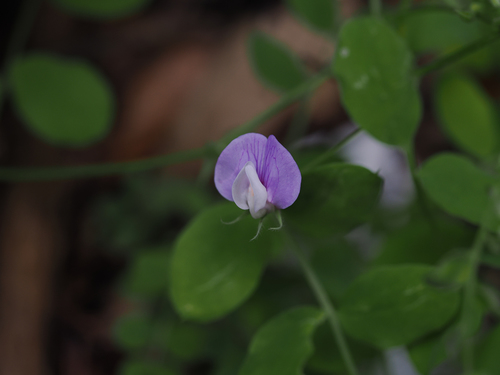
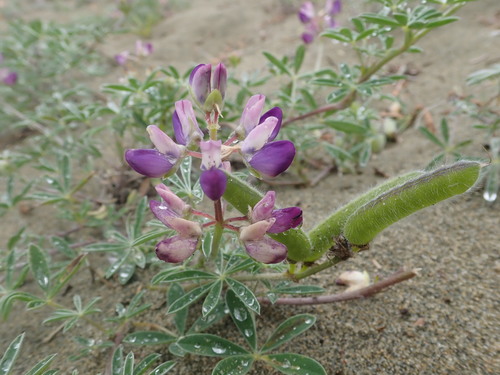
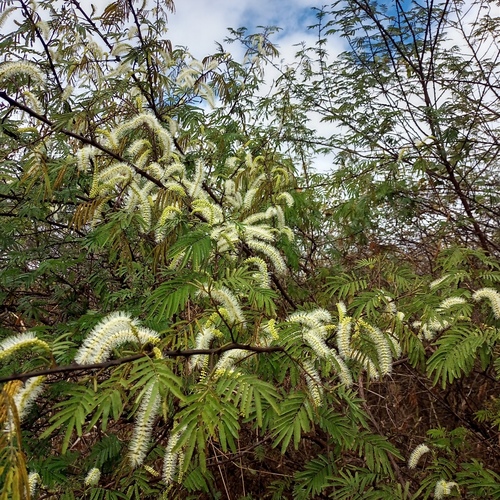
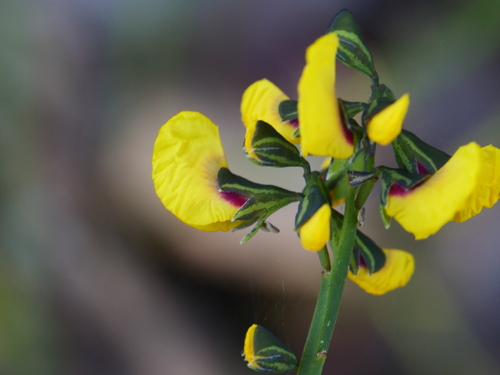
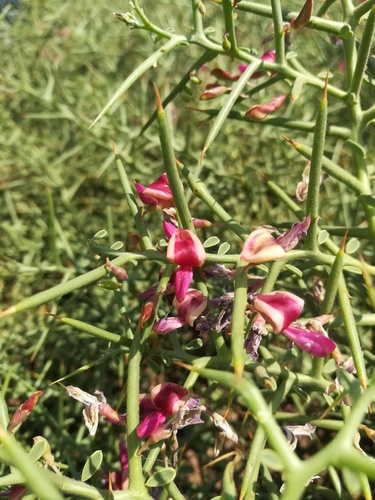
Alhagi maurorum Medik. is a perennial plant that grows from an extensive massive rhizome system, which can reach over 1.8 metres (6 ft) deep into the ground. New shoots of this plant can emerge over 6 m (20 ft) away from the parent plant. Above ground, the plant reaches a maximum height of 0.9 metres (3 ft). It forms a heavily branched, gray-green thicket, with long spines running along its branches. Its deciduous leaves are oval to egg-shaped, and grow up to 1 centimetre (1⁄2 in) long. The plant produces small bright pink to maroon pea flowers that are up to 1 cm (3⁄8 in) long, followed by small brown or reddish legume pods. The pods reach up to 2.5 cm (1 in) in length, and are constricted between the individual seeds. The seeds themselves are mottled brown beans. Alhagi maurorum is native to temperate and tropical Eurasia and the Middle East, with confirmed native occurrences in Afghanistan, Armenia, Azerbaijan, northwest China, Cyprus, northern India, Iran, Iraq, Israel, Jordan, Kazakhstan, Kuwait, Lebanon, Mongolia, Pakistan, Syria, Tajikistan, Turkey, Turkmenistan, Uzbekistan, and Russia (specifically Ciscaucasia, Dagestan, southern European Russia, and the southern part of the West Siberian Plain). It has become naturalized in Australia, the southwest United States, and southern Africa. Outside of its native range, Alhagi maurorum is classified as a noxious weed. It is a common contaminant of alfalfa seed, and grows easily when accidentally introduced to cultivated fields. It tolerates a wide range of soil conditions, growing well in saline, sandy, rocky, and dry soils, and performs best when growing near a water source such as an irrigation ditch. It is unpalatable to animals, and becomes an irritant when it invades forage and grazing land. Alhagi maurorum has been used locally in folk medicine to treat glandular tumors, nasal polyps, and bile duct-related ailments. It is used as a medicinal herb for its gastroprotective, diaphoretic, diuretic, expectorant, laxative, antidiarrhoeal, and antiseptic properties, and is also used to treat rheumatism and hemorrhoids. The plant is referenced in the Quran as a source of sweet manna, and has also been used as a sweetener. In Iranian folk medicine, a decoction of A. maurorum has been used for jaundice therapy.