About Algidia chiltoni Roewer, 1931
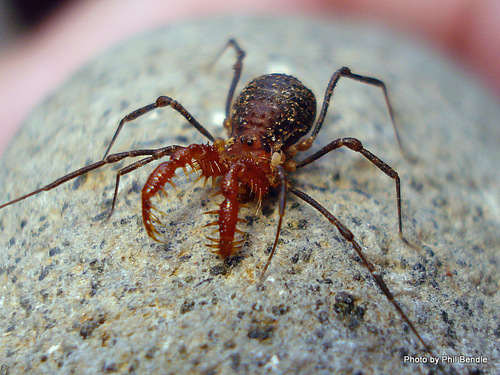
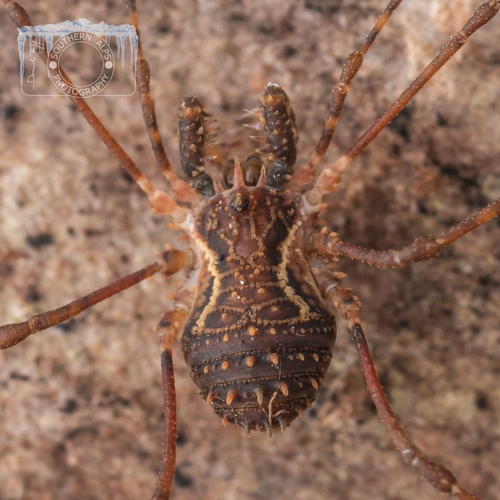
This is a description of the subspecies Algidia chiltoni chiltoni, which shares the general characteristics of the genus Algidia, and most closely resembles the other two subspecies A. c. longspinosa and A. c. oconnori. Among male A. c. chiltoni, the tubercles (pointed protuberances) on the eyemound are shorter and more numerous than those of A. c. longispinosa, and shorter and less numerous than those of A. c. oconnori. Males can also be distinguished by the characteristics of tubercles on the rear margin of the scutum (the unsegmented portion of the carapace) and the free tergites (the segmented rear area). These tubercles are thicker in A. c. chiltoni than in the other two subspecies. Additionally, A. c. longispinosa has fewer tubercles on the rear margin of the scutum and the first two free tergites than A. c. oconnori. The femur of the male pedipalp has a proximo-dorsal (upper surface, near the body) swelling with a spinous tubercle, which matches the condition found in A. c. longispinosa, but this feature is not present in A. c. oconnori. However, the dorsal tubercles on this femur are shorter in A. c. chiltoni, and the ventral tubercles are both shorter and less numerous than in A. c. longispinosa. Females of A. c. chiltoni share these two tubercle characteristics, allowing them to be distinguished from females of A. c. longispinosa; females of A. c. oconnori have not been described. Algidia chiltoni chiltoni is distributed as far north as Auckland in the North Island of New Zealand, on Stephens Island at the northern tip of the Marlborough Sounds, and in the Tasman region and northernmost part of the West Coast region of the South Island. It is sympatric with both A. c. longispinosa and A. c. oconnori.