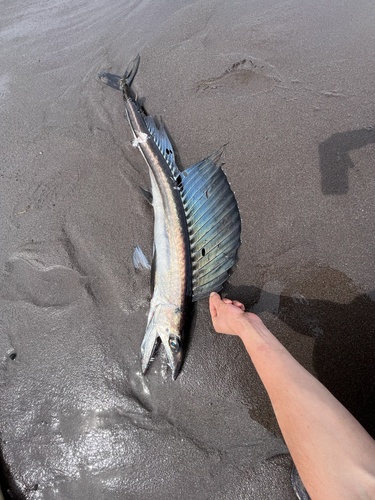
About Alepisaurus ferox Lowe, 1833
Alepisaurus ferox, described by Lowe in 1833, is commonly called the long snouted lancetfish, longnose lancetfish, or cannibal fish. It is a species of lancetfish that occurs in ocean depths down to 1,830 metres (6,000 feet). Members of this species reach a maximum total length of 215 centimetres (85 inches) and a maximum weight of 9 kilograms (20 pounds). The common name 'cannibal fish' comes from the discovery of partially digested individuals of the same species (conspecifics) inside captured specimens. A. ferox inhabits deep open ocean waters across a wide range. It is found in the Western and Eastern Pacific Ocean, from the Aleutian Islands south to Chile; in the Western Atlantic Ocean, from the Gulf of Maine to the Gulf of Mexico, including the Caribbean Sea; and it also occurs in the Northwest and Eastern Atlantic, the Indian Ocean, and the China Sea. It can be found as far north as Russia. Due to its very broad distribution, this species is often caught accidentally by some tuna fisheries. To search for food, A. ferox carries out daily vertical migrations, moving from the epipelagic zone down to the mesopelagic or bathypelagic zones. This species is simultaneous hermaphroditic: each individual has both male and female reproductive organs at the same time. Unlike other hermaphroditic fish, A. ferox has two separate testicular lobes that are not connected to the ovarian region. Additionally, the female reproductive region of this species lacks a pair of diverticulae, a structure that other hermaphroditic fish use for spermatophore uptake.

