About Aleeta curvicosta (Germar, 1834)
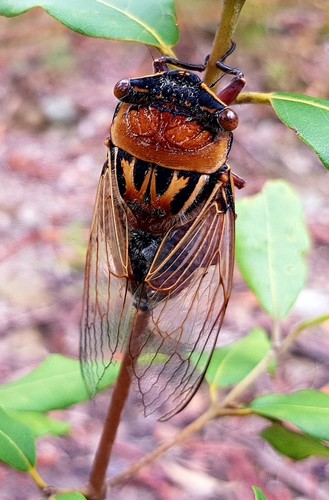
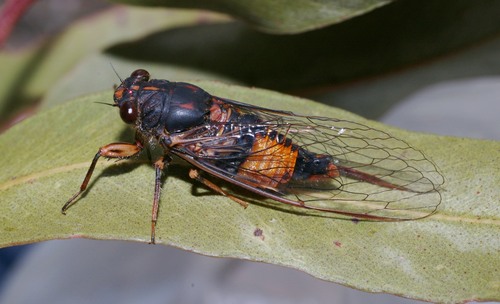
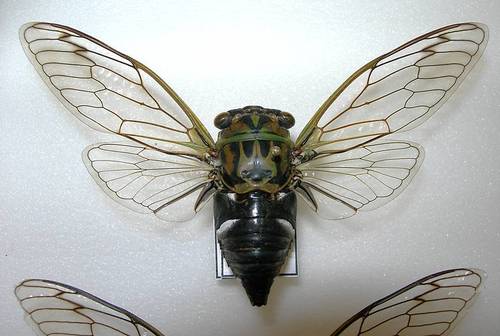
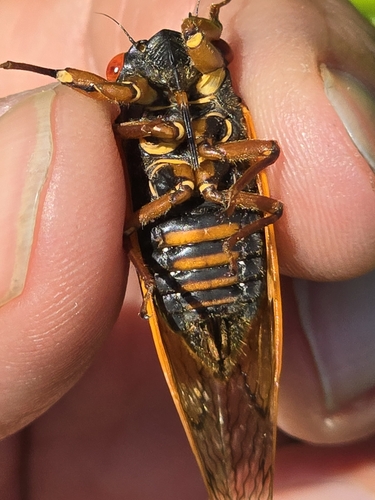
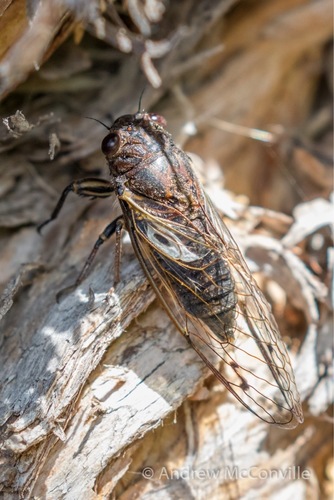
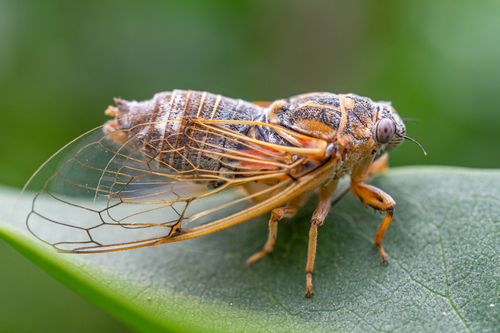
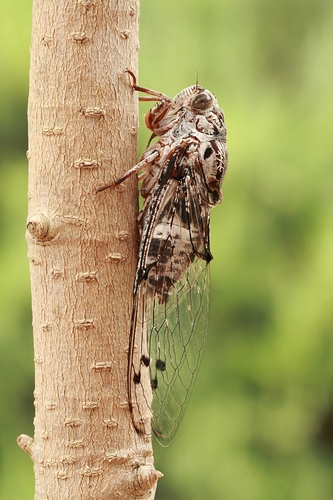
Aleeta curvicosta, commonly called the floury baker, is a medium-sized cicada. It has a body length of 2.9 cm (1.1 in), forewings 3 to 5.1 cm (1.2 to 2.0 in) long, a wingspan of 9–10 cm (3.5–4 in), and an approximate weight of 1.02 g (0.036 oz). Individual size varies markedly by region depending on local rainfall: in areas with average annual rainfall over 1,000 mm (39 in), which are mostly coastal, individuals are much larger, with average forewing lengths roughly 1 cm (0.4 in) longer than those in low-rainfall areas. Adult floury bakers are brown with a white-dusted appearance: white downy filaments cover most of the body, legs, and some wing veins, but this silver body fur rubs off easily, so it is often substantially reduced in older adults and museum specimens. While individuals have a range of body markings, all have a pale midline on the pronotum. Their legs are brown, sometimes yellowish, with no distinct markings. Their average dry mass makes up 36.2% of their total body mass, a higher proportion than most Australian cicadas, which suggests the species has strong exoskeletal armour. They have dark brown eyes and yellowish opercula that extend laterally well beyond the body. Females are slightly larger than males, and generally share the same colour and markings, though they may be slightly paler in some areas. A female's ninth abdominal segment is long and dark reddish-brown, sometimes partially darkening toward black. Her ovipositor is long and tilted downward, and the ovipositor sheath is black or dark reddish brown. The wings are transparent with black or brown veins, and a brown-black patch at the base of apical cells 2 and 3. These patches sometimes fuse into a continuous zigzag of dark brown to black discolouration. The basal cell is often opaque and amber-coloured. Like on many insects, both sides of the wing membranes are coated with a repeating pattern of cuticular nanostructures around 200 nm in height, separated by approximately 180 nm. These structures are thought to help with anti-reflective camouflage, anti-wetting, and self-cleaning. Male calls can be heard at any time of day, and are an unusual hissing-type sound. It starts as a series of one-second sibilant bursts roughly one second apart, which repeat more rapidly until they become a constant hiss that lasts 7–10 seconds. The call is described as "rp, rp, rp, rp, rrrrrp". The sound is produced when single muscular contractions click the tymbal inward, buckling 7–9 of the tymbal ribs, and each rib produces a pulse. This action occurs alternately on the two tymbals and repeats rapidly at a frequency of around 143 Hz; pulses are grouped in fours except when the cicada is in distress, in which case pulses are ungrouped and at a lower frequency. This gives a pulse repetition frequency of around 1050 per second, with a relatively broad sound frequency range of 7.5–10.5 kHz, and a dominant frequency (where peak energy is observed) of 9.5–9.6 kHz. Abdominal tracheal air sacs surround the sound muscles and extend into the abdomen, acting as resonant chambers to amplify sound. Floury bakers rapidly extend or raise their abdomen, which changes how the air sacs affect the sound to alter its volume, pitch, or tune during the introduction to the free song. This call can be heard when a cicada is undisturbed in its natural environment, and males use these calls to attract females. The species is one of Australia's loudest cicadas, and has been called "the best musician of them all". The floury baker can be distinguished from the similar undescribed species A. sp. nr. curvicosta (the little floury baker) by the structure of the male genitalia and its audibly distinct call. Members of the genera Aleeta and Tryella are easily distinguished from other Australian cicadas because they lack tymbal covers, and the costal margin of their forewings becomes larger toward the point where the wing attaches to the body. In these genera, the costal margin is clearly wider than the costal vein. The floury baker is found from the Daintree River in North Queensland to Bendalong in southern New South Wales. In the northern part of its range it is a highland species, restricted to the Atherton Tableland and Eungella National Park west of Mackay, but it is a mostly lowland species across the rest of its range. It can be found in a variety of habitats, from rainforest margins to suburbs, even in the centre of Sydney. Female floury bakers lay eggs in a series of slits that they cut into live branches or twigs of their food plants with their ovipositor. On average, around sixteen eggs are laid in each slit, out of a total batch of a few hundred eggs. The entire batch hatches around 70 days later, usually within one to two days of one another, though hatching takes longer in cold or dry conditions. Oviposition has been observed on a wide range of native and introduced plant species, and it can weaken the branches of young orchard trees such that the branches cannot support the weight of their fruit. After hatching, nymphs fall from the branches to find a crack in the soil, where they burrow, often to a depth of 10–40 cm (4–15.5 in), digging with their large forelegs. Larger cicada species like A. curvicosta are thought to spend 2–8 years underground, where they grow and feed on tree root sap through their rostrum. They moult five times before emerging from the ground to shed their final nymphal shell. Although emergence always takes place at night, the population's emergence is spread diffusely over the season compared to higher-density Australian cicada species. The sex ratio is around 1.15 males for every female, which stays consistent throughout emergence. Over a period of around 6.5 hours during emergence, A. curvicosta's metabolic rate is roughly 1.8 times the adult's resting metabolic rate. A study in South East Queensland found that nymphs would emerge on most tree species but avoid Norfolk pine (Araucaria heterophylla) and broad-leaved paperbark (Melaleuca quinquenervia). Adults are usually found between November and May, but are sometimes observed as early as September and as late as June. They have been recorded appearing every year, mainly in December and January in western Sydney; a similar 92-day emergence period from late November to late February was recorded in South East Queensland. This makes it one of the last Australian cicadas to emerge each season. To emerge, the nymph grips tree bark with all its legs, swallows air, and redistributes haemolymph to split the nymphal shell down the center of its back. It then pulls its head and clypeus out by hunching its body, and after these emerge, it arches backward to pull its legs out of the casing. It next slowly unfolds its wings, finally bends forward and grips the front of the old shell to free its abdomen. Once free, it hangs for several more hours as its wings harden. After reaching adulthood, most adult cicada species live for another two to four weeks. During this time they feed on flowing sap from tree branches, and mating and egg laying occur.