About Alectroenas madagascariensis (Linnaeus, 1766)
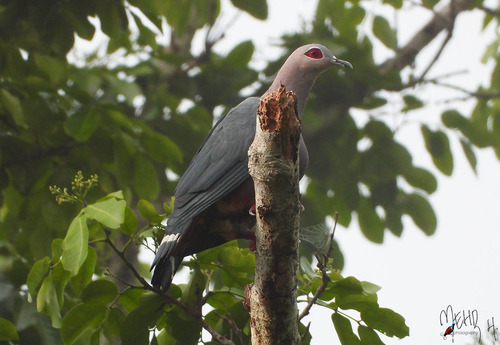
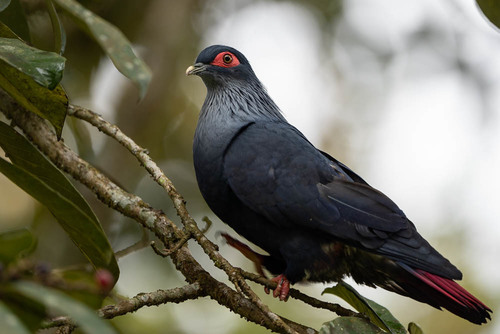
Alectroenas madagascariensis, commonly called the Madagascar blue pigeon, measures 25 to 27 cm (9.8–10.6 in) in length. As its common name suggests, its plumage is dominated by various shades of blue. The neck and throat are silvery blue-grey, with filamentous plumes; the upper parts of the body are silvery-grey, and the breast is blue-grey that transitions to deep blue on the belly. The tail is deep red. The head is blue, with a large patch of bare red skin surrounding the yellow eye. The feet are red, and the small bill is greenish with a yellow tip.
Its natural habitats are tropical moist lowland forests and subtropical or tropical moist montane forests, including both undisturbed and degraded forest areas. It occurs from sea level up to 2,000 m (6,600 ft) in elevation. Within its habitat, this species is most often seen in tree tops and on branches above the forest canopy. The species appears to be partially migratory: it leaves the northern part of Madagascar for part of the year, and moves west during the rainy season. Additional research is required to fully understand this migratory behaviour.
Little is known about the general behaviour of the Madagascar blue pigeon. It has been observed feeding on fruit, and can be seen either foraging in pairs or in small groups of up to 12 birds. Its nests are simple twig platforms, positioned 6–20 m (20–66 ft) up a tree, and a clutch contains only one egg.