About Alectoris rufa (Linnaeus, 1758)
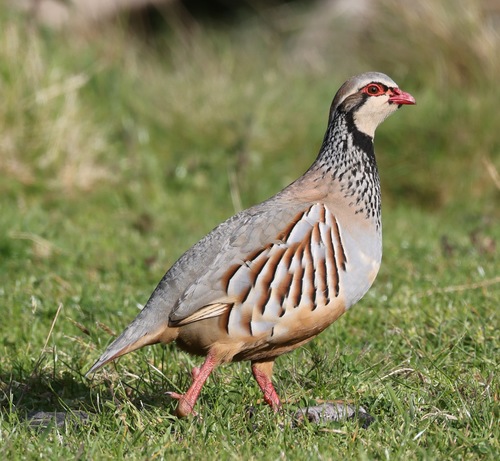
Alectoris rufa, commonly called the red-legged partridge, has the following adult physical description. Adult red-legged partridges are sandy-brown on their upperparts, pinkish-buff on the belly, and pale grey on the breast. They have a prominent black-streaked gorget, bold rufous and black bars on the flanks, a cream throat, pink legs, and a red bill and eye ring. The crown and upper nape are warm pinkish-brown, while the fore crown and lateral edges of the crown are pale blue-grey. A narrow off-white supercilium runs from above the lores to the sides of the lower nape. The lores have a solid bar of black feathers above a patch of pinkish-red skin. This black coloring continues behind the eye, where it broadens, then extends down around the throat patch to meet the upper edge of the gorget. A patch of pale buff-brown feathering sits on the ear-coverts, adjoining the black. The eye is surrounded by a bright red eye ring. The chin and upper throat are creamy-white, bordered behind and below by a solid black gorget. The black color extends down onto the lower throat as a patch of broad triangular black streaks on a pale sandy-grey background. Similar but narrower black streaks appear on a pale blue-grey background on the upper neck sides, while the lower neck sides are warm pinkish-brown. The breast is pale blue-grey, and the belly is pinkish-buff. The flanks are marked with bold bright rufous-brown bars, usually between eight and ten total. Each bar has a narrow black leading edge; the background color is off-white in front of each bar, and pale grey behind. The upper parts are plain, unmarked dark sandy-grey. The uppertail-coverts match this color, and contrast with the pinkish-rufous tail feathers. The bill is bright red, the iris is medium brown, and the legs are pinkish-red. For distribution and habitat, this partridge breeds naturally in southwestern Europe, including France, the Iberian Peninsula, and northwest Italy. It was introduced to England and Wales as a game species, and has become naturalized in flat areas there, with breeding recorded as far north as Sutherland. It is replaced in southeastern Europe by the very closely similar rock partridge, Alectoris graeca. This is a non-migratory terrestrial species that forms flocks outside of the breeding season. It breeds on dry lowlands, such as farmland and open stony areas, and lays its eggs in a ground nest. It has been recorded cohabiting with wild rabbits. For cultivation and consumption, red-legged partridges are bred for shooting, and are sold and eaten as game.