About Alectoris chukar (J.E.Gray, 1830)
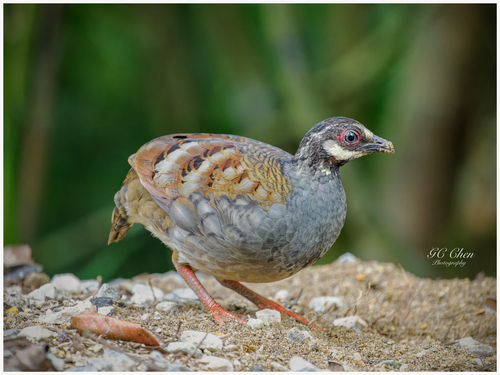
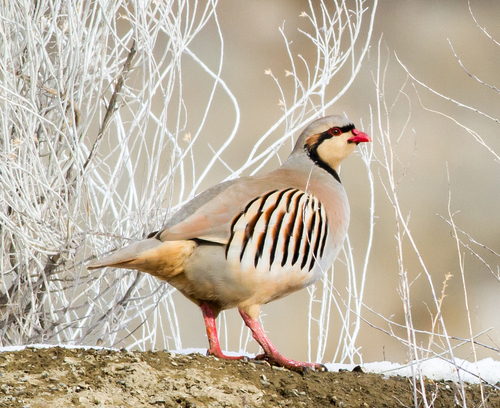
The chukar, Alectoris chukar (J.E.Gray, 1830), is a rotund partridge that measures 32–35 cm (13–14 in) in length. It has a light brown back, grey breast, and buff belly, with shade variations across different populations. Its face is white marked with a black gorget, it has rufous-streaked flanks, red legs, and a coral red bill. The sexes look similar; females are slightly smaller and lack the spur found on males. Its tail has 14 feathers: the third primary feather is the longest, while the first primary is level with the fifth and sixth primaries. This species is very similar to the rock partridge (Alectoris graeca), with which it was once grouped, but it is browner on the back and has a yellowish tinge on the foreneck. A sharply defined black gorget distinguishes the chukar from the red-legged partridge, whose black collar breaks into dark streaks near the breast. The chukar gets its name from its characteristic noisy song: chuck-chuck-chukar-chukar. Compared to the Barbary partridge (Alectoris barbara), which has a reddish-brown rather than black collar, a grey throat and face, and a chestnut crown, the chukar is clearly distinct. Other common names for this bird include chukker, chuker, chukor, Indian chukar, and keklik.
This partridge is native to Asia, where its range covers Israel, Jordan, Palestine, Lebanon, Syria, the United Arab Emirates, Saudi Arabia, Oman, Turkey, Kurdistan, Iran, Afghanistan, Tajikistan, Pakistan, India along the inner ranges of the western Himalayas to Nepal, and the southeasternmost part of Europe in Bulgaria and Greece. Further west in southeastern Europe, the chukar is replaced by the rock partridge Alectoris graeca. It barely extends into Africa, only reaching the Sinai Peninsula. In its native range, it inhabits rocky open hillsides with grass, scattered scrub, or cultivation. In Israel and Jordan, it occurs at low altitudes, starting 400 m (1,300 ft) below sea level in the Dead Sea area, while in more eastern regions it is mostly found between 2,000 and 4,000 m (6,600 and 13,100 ft) altitude, with the exception of Pakistan where it occurs as low as 600 m (2,000 ft). It does not live in areas with high humidity or high rainfall.
The chukar has been widely introduced as a game bird, and feral populations have become established in the United States (Rocky Mountains, Great Basin, high desert areas of California), Canada, Chile, Argentina, New Zealand, and Hawaii. Initial introductions to the United States came from nominate populations collected in Afghanistan and Nepal. Chukars are hunted across the dry, rocky Columbia Basin, especially around the Snake River in Washington and Oregon. It was also introduced to New South Wales in Australia, but breeding populations have not persisted there and are probably extinct. A small population has existed on Robben Island in South Africa since its introduction there in 1964. Chukars readily interbreed with red-legged partridges (Alectoris rufa), and the practice of breeding and releasing captive-bred hybrids has been banned in multiple countries including the United Kingdom, as it threatens wild red-legged partridge populations.
During the non-breeding season, chukar partridges live in small coveys of 10 or more birds, reaching up to 50 individuals. In summer, chukars form pairs to breed. During this period, male cocks are very aggressive in their calling and fighting. In winter, they descend into valleys to feed in fields. They call frequently throughout the day, especially in the mornings and evenings. Their call is loud, consisting of repeated loud chuck notes, and sometimes includes duetting chuker notes. Multiple calls that vary by context have been recorded. The most common call is a "rallying call"; playing this call back elicits a response from wild chukars and has been used for population surveys, though the method is not very reliable. When disturbed, chukars prefer to run rather than fly, but will fly a short distance if needed, often gliding down a slope on rounded wings and calling immediately after landing. In Utah, foraging chukars were found to use an area of about 2.6 km2 (1.0 sq mi) and travel up to 4.8 km (3.0 mi) to reach water during the dry season. Chukars in Idaho have been recorded with even smaller home ranges.
The breeding season occurs in summer. Males perform tidbitting displays, a form of courtship feeding where the male pecks at food to attract a female, who may visit and peck in response. Males may also chase females with their head lowered, one wing lowered, and neck fluffed. Males may also perform a high-stepping stiff walk while giving a special call. If the female accepts the male, she crouches, and the male mounts to copulate while grasping the back of her neck. Males are monogamous. The nest is a shallow ground scrape with sparse lining, though occasionally chukars create a compact pad with a central depression. Nests are generally sheltered by ferns and small bushes, or placed in a depression or on a rocky hillside under an overhanging rock. Females lay between 7 and 14 eggs, which hatch after about 23–25 days of incubation. In captivity, females can lay one egg per day during the breeding season if eggs are collected daily. After hatching, chicks join their parents to forage, and will soon merge into the covey with chicks from other pairs. As young chukars grow, and before their first flight, they use wing-assisted incline running as a transition to adult flight. This behaviour occurs in multiple bird species, but it has been widely studied in chukar chicks to explain the evolution of avian flight.
Chukars eat a wide variety of seeds and some insects, and they ingest grit to aid digestion. In Kashmir, seeds of an Eragrostis species were especially dominant in their diet, while chukars in the United States favour Bromus tectorum. Chukars that feed on succulent vegetation can meet their water requirements, but still visit open water sources in summer. Chukars roost on rocky slopes or under shrubs. In winter, chukars in the United States select protected niches or caves for roosting. Groups may roost in a tight circle with their heads pointed outward to conserve heat and watch for predators. Chukars are sometimes preyed on by golden eagles. Captive chukars can die from Mycoplasma infection and outbreaks of other diseases such as erysipelas.