About Alectoria sarmentosa (Ach.) Ach.
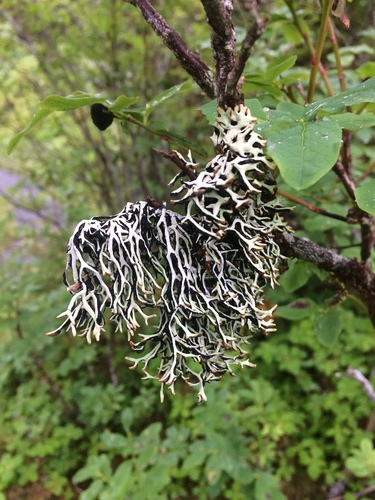
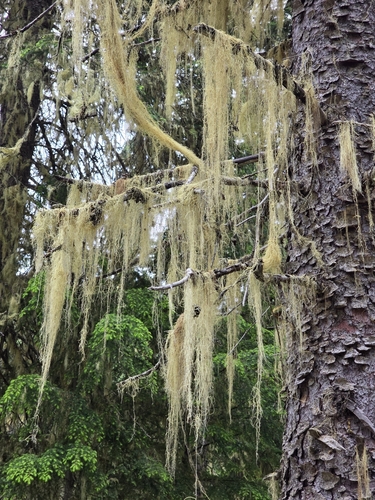
Alectoria sarmentosa (Ach.) Ach. is a species of lichen with a fruticose, stringy, extensively branched body called a thallus. Each branch usually divides into two to four sections, and thicker branches are typically more than 2.5 mm in diameter. This lichen is an epiphyte, meaning it has no roots and gets all its moisture and nutrients from the air and rain. Among Alectoria species, which vary in overall color, A. sarmentosa ranges from grayish green to yellowish green, occasionally turning black towards the tips of its branches, with small white raised ridges across its surface. Its thalli form large hanging mats 10 to 30 cm long that grow in a pendulous, hanging fashion; some mats form dense, curtain-like clusters. A. sarmentosa is easily fragmented by wind. This species is found across temperate rainforests of the northern hemisphere, which lie in the temperate zone and receive between 846 mm and 5600 mm of annual precipitation. Alectoria species and subspecies have a global distribution, and A. sarmentosa occurs in Pacific Northwest Coast forests, including Alaska, coastal British Columbia, Oregon, Washington, and northern California, west of Alberta and Montana. It has also been identified in the Appalachian Mountains temperate rainforest of the eastern United States, the boreal rainforests of New Brunswick and Nova Scotia, Canada, and in Scandinavian coastal conifer forests. It is common in boreal or taiga forests and prehumid rainforests, and typically grows at transitions between valley and mountain forests at low to mid elevations, avoiding the immediate coast. A. sarmentosa is commonly associated with old growth forests in these regions, and is highly dependent on forest structure (including canopy height, cover, and composition), edge characteristics, and climate. It dominates the edges of canopy gaps, where sunlight reaches the lower to mid levels of the forest canopy. In these old growth areas, A. sarmentosa grows on bark and wood, hanging pendulously from the branches of conifer trees, hardwood trees, and deciduous shrubs. It is rarely found growing on rock or mosses covering rock, and is sometimes found on the ground after being fragmented and blown down by wind. Most lichens reproduce via small, saucer-shaped fruiting bodies called apothecia, but these structures are not typically seen in Alectoria species. The genus name Alectoria means 'unmarried', which refers to this lack of apothecial fruiting bodies. Since A. sarmentosa does not produce these sexual fruiting bodies, it reproduces asexually: fragments of the thallus are blown off a branch, and grow into new individuals when they land on another branch of a nearby or existing conifer or shrub. Alectoria sarmentosa gets its pale yellow-green color from usnic acid, and has distinct ecological preferences compared to darker melanic hair lichens. Studies in coniferous forests show this species reaches its highest abundance in more sheltered locations, particularly on north-facing slopes and in lower canopy positions where light levels are moderate. While A. sarmentosa can successfully establish in relatively young forests around 60 years old, it is widely considered an indicator or associate of old-growth forests. The species benefits from humid conditions, and its cortical structure is optimized to transmit light to its underlying photobionts in shaded sites. Unlike melanic hair lichens, A. sarmentosa has lower tolerance for high light exposure, especially in drier regions, because its cortex is relatively transparent when dry. This habitat preference reflects an evolutionary adaptation where its pale pigmentation and thallus structure are optimized for efficient photosynthesis in shadier, more humid forest conditions. Alectoria sarmentosa and similar species provide good nutrition for animals, and form an important winter food source for browsing wildlife. Sitka black-tailed deer and caribou eat this lichen from accessible low branches, or from the ground when it is blown down onto snow during winter storms. Flying squirrels both include A. sarmentosa in their diet and use it as material for building nests. Many indigenous peoples of the Pacific Northwest Coast, including the Nuxalk people of Canada, used fibers from Alectoria lichens including this species. The fibers were particularly useful for making baby diapers and bandages, and were also used as decorative false whiskers and hair to adorn dance masks. Some interior Alaskan and Canadian indigenous peoples wove ponchos and footwear from A. sarmentosa fibers, though this clothing was of lower quality than clothing made from animal hides.