About Alectis ciliaris (Bloch, 1787)
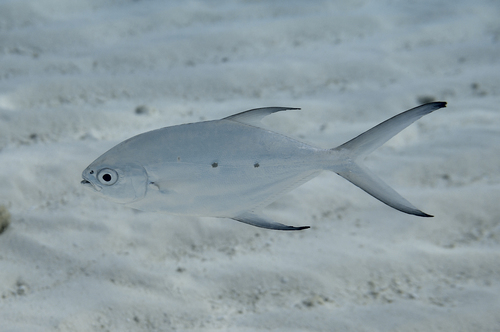
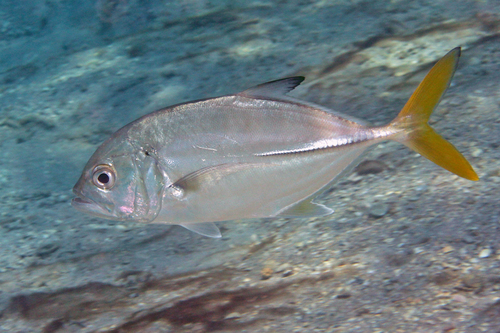
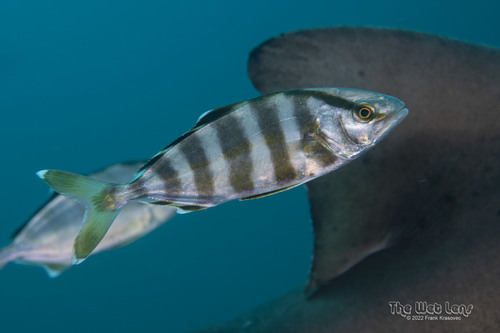
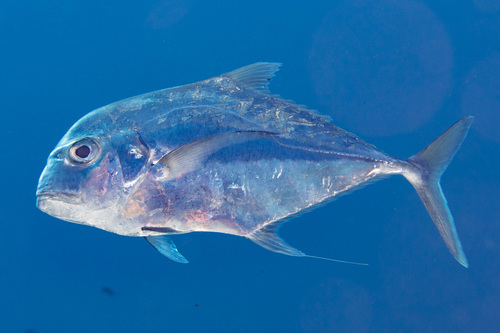
Like many members of the Carangidae family, the African pompano (Alectis ciliaris) is a deep-bodied, laterally compressed fish. The deepest point of its body lies between the origins of the dorsal and anal fins, with the head and tail tapering outward from this point on either side. Both its dorsal and ventral body profiles are equally convex. A key distinguishing feature of adult African pompano is a more curved head, compared to the more angular head profile of Alectis indicus. This species has four to seven visible spines in the first dorsal fin, followed by one spine and 18 to 20 soft rays in the second dorsal fin. The anal fin has two spines followed by 15 or 16 soft rays, while the pectoral fin is long and curved. The skin of the fish appears scaleless, but it actually has tiny, embedded scales scattered across the body. The lateral line forms a strong, moderately long upward arch, and the posterior section of the lateral line holds 12 to 30 scutes. Juveniles of this species are distinctive for their 'threadfin' appearance, with trailing filaments on their dorsal and anal fins that recede as the fish ages. As the species matures, its body also becomes more elongated, growing to resemble jacks from other genera more closely. The upper body of the African pompano ranges from silvery-metallic blue to blue-green in color, darkest on the head and upper shoulders, while the underside is a more plain silvery shade. Juveniles have five chevron-shaped dark bars on their bodies, plus a black blotch at the base of the third through sixth soft dorsal fin rays. The base of the fin filaments is dark blue to black, and all other fins are pale to hyaline. The African pompano definitely reaches a maximum length of 130 cm; larger specimens up to 150 cm have been reported, but these reports are not considered reliable. The maximum published weight for the species is 22.9 kg. The African pompano is distributed across all tropical oceans and seas of the world, where it lives in water temperatures between 18 to 27 °C (65 to 80 °F), and it is most often found in coastal waters. It has been recorded on both the east and west coasts of the US, South America, and Africa; throughout the Indian Ocean; along the coasts of Asia and Australia; and around many Pacific islands. The species' range extends into more temperate waters: juveniles in particular have been captured off southeastern and western Australia, and are presumed to have been carried to these areas by ocean currents. Adult African pompano prefer coastal waters up to depths of 100 m, and inhabit reefs and wrecks throughout the water column. Juveniles are naturally pelagic, and live in both coastal areas and open ocean. Their dependence on water currents means they occasionally enter estuarine waters in southern Australia, but they cannot survive cold winter temperatures there. In one unusual observation, the abundance of African pompano off North Carolina increased dramatically after a hurricane passed through the region. The African pompano is a schooling predatory fish. It feeds predominantly on a variety of crustaceans, including decapods, carids, and copepods, and also eats cephalopods and small fish. It is preyed on by larger fish including mackerel, tunas, and sharks. The small, pelagic juveniles have filamentous dorsal and anal fins that resemble jellyfish medusae, and this mimicry may provide some protection from predators. Little is known about the species' reproductive habits or maturation lengths. A study conducted in India found that A. ciliaris larvae peak in abundance during April. Eggs of this species are spherical and pelagic, and contain a yolk and an oil globule; the larvae were also extensively described in this study. Spawning is thought to occur over sandy substrates in spring in Mexico.