About Aldabrachelys gigantea (Schweigger, 1812)
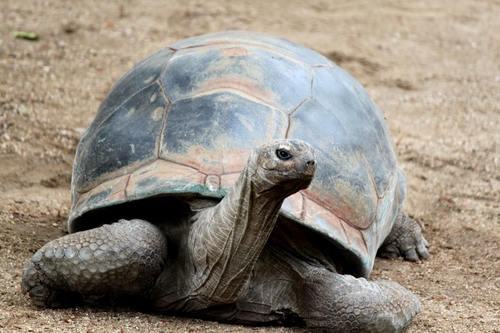
The scientific name of this species is Aldabrachelys gigantea (Schweigger, 1812). The carapace of A. gigantea is brown or tan, with a high, domed shape. The species has stocky, heavily scaled legs that support its heavy body. Even for its great overall size, the Aldabra giant tortoise has a very long neck, which helps it reach tree branches up to one meter from the ground as a food source. Aldabra giant tortoises are similar in size to the well-known Galápagos giant tortoise, with an average carapace length of 122 cm (48 in). Males have an average weight of 250 kg (550 lb). Females are generally smaller than males, with an average carapace length of 91 cm (36 in) and an average weight of 159 kg (351 lb). Medium-sized specimens kept in captivity have been reported to have a body mass of 70 to 110 kg (150 to 240 lb). Another study found that body masses up to 132 kg (291 lb) are the most commonplace. The main population of the Aldabra giant tortoise lives on the islands of the Aldabra Atoll in the Seychelles. This atoll has been protected from human influence, and is home to around 100,000 giant tortoises, which is the world's largest population of the animal. Smaller populations of A. gigantea in the Seychelles can be found on Frégate Island and in the Sainte Anne Marine National Park, for example on Moyenne Island, where the tortoises are a popular tourist attraction. Conservationists have also reintroduced 50 small individuals to Aride Island, where they join 10 larger tortoises that were rehomed there previously. Another isolated population of the species lives on the island of Changuu, near Zanzibar. Other captive populations are held in conservation parks in Mauritius and Rodrigues. The tortoises use many different types of habitat, including grasslands, low scrub, mangrove swamps, and coastal dunes. A unique habitat type called 'tortoise turf' has coevolved in response to the grazing pressure of these tortoises: this habitat is a mix of over 20 species of grasses and herbs. Many of these distinct plant species are naturally dwarfed, and grow their seeds closer to the ground instead of on the upper parts of the plant, to avoid being cut by the tortoises' close-cropping jaws. As the largest animal in its native environment, the Aldabra giant tortoise fills an ecological role similar to that of an elephant. Their active search for food knocks down trees and creates pathways that are used by other animals. Aldabra giant tortoises are primarily herbivores, and eat grasses, leaves, woody plant stems, and fruit. They occasionally eat small invertebrates and carrion, and will even consume the bodies of other dead tortoises. In captivity, Aldabra giant tortoises are known to eat fruits such as apples and bananas, as well as compressed vegetable pellets. In 2020, a female Aldabra giant tortoise on Fregate Island was observed hunting and eating a juvenile lesser noddy, which indicates that the species is in the process of learning to catch birds. Little fresh water is available for drinking in the tortoises' natural habitat, so they get most of their moisture from the food they eat. There are two main shell varieties of the Aldabra giant tortoise, which correspond to their different habitats. Specimens that live in habitats where food is primarily available on the ground have more dome-shaped shells, with the front portion of the shell extending downward over the neck. Specimens that live in environments where food is available higher above the ground have flatter top shells, with the front portion raised to allow the neck to extend upward freely.