About Alcyonium digitatum Linnaeus, 1758
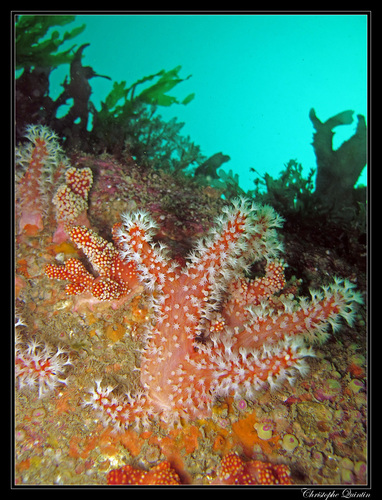
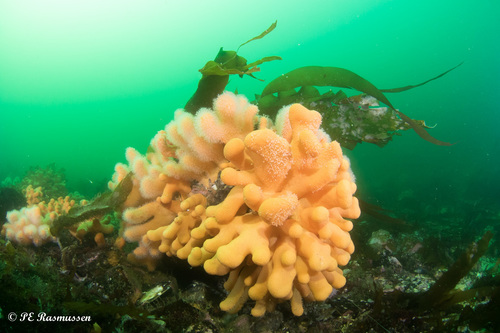
Dead man's fingers, the common name for Alcyonium digitatum Linnaeus, 1758, is a colonial coral that forms clumps of yellow, white, or cream-colored fleshy masses made of finger-like lobes. Its surface layer contains many sclerites, which form a crust. The individual polyps are white and translucent. When feeding, they project out from the leathery colony surface, giving the entire colony a furry appearance. This species is found along the Atlantic coasts of north-west Europe, ranging from Portugal to Norway. Most recently, it was discovered in the uncharted waters of Jammerbugt bay off the north-west coast of Denmark by a 2020 seafloor mapping project led by explorer Klaus Thymann. It also occurs in parts of Canada, the northeastern coast of the United States, the Gulf of Maine, the Bay of Fundy, and the northern waters of New Zealand. Polyps grow in colonies attached to bedrock, boulders, and stones; they occasionally attach to the shells of crabs and gastropods. Colonies are most abundant in areas with strong water movement, where sunlight levels are too low for algae to become dominant. They are usually found in the sublittoral zone, at depths down to approximately fifty metres. This coral is common around the coasts of Britain and Ireland. Two related species, Alcyonium glomeratum and Alcyonium hibernicum, are also found in this region, but both are much rarer, so misidentification is unlikely.