About Alcyonium coralloides (Pallas, 1766)
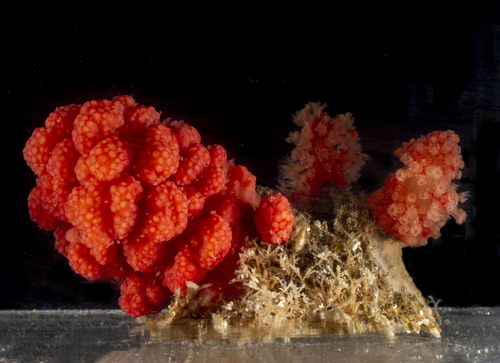
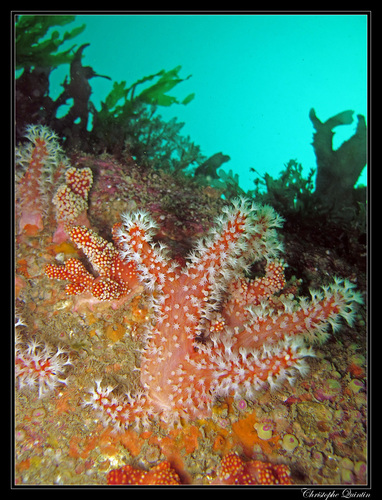
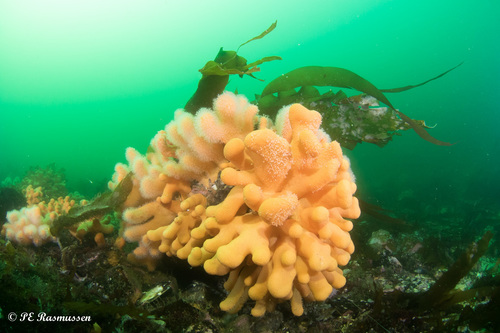
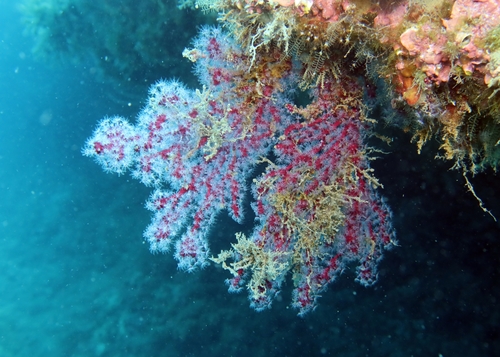
Alcyonium coralloides (Pallas, 1766) displays multiple distinct growth habits, which vary by region. In the Atlantic Ocean, it sometimes grows as encrusting red sheets across rock surfaces, these sheets have white or yellow polyps and may feature bare areas with no polyps. More often, Atlantic colonies form short, finger-like lobes up to 4 cm (1.6 in) long, which are pale pink with white polyps. It rarely forms encrusting growths on sea fans in the Atlantic. In the Mediterranean Sea, Alcyonium coralloides most often grows as an encrusting organism covering the surface of gorgonians (sea fans). Since the sea fan provides a rigid supporting skeleton, this species does not need its own supportive skeleton. However, it does have spicules in its surface layers, which give it a rough texture when touched. Mediterranean colonies are most often purple, but may also be white, pink, or yellow. White and pink forms are mostly found in deep water and are classified as mutants. The polyps are usually white, cream, or yellow, may reach 5 mm (0.2 in) in length, and are typically larger than the polyps of the host sea fan it encrusts. Alcyonium coralloides can be considered parasitic, because it kills the sea fan's tissue and adheres to the underlying host skeleton. The mechanism that allows it to kill host tissue is not currently understood. Occasionally, Mediterranean colonies take on the lobed growth form seen in Atlantic populations. Alcyonium coralloides is abundant in the Mediterranean Sea, but it is less common along the Atlantic coast of Western Europe and in the English Channel. The northernmost limit of its range is Scotland. In the Atlantic Ocean, its colonies are small and grow directly on vertical rock faces, beneath overhangs, and inside caves. In the Mediterranean, colonies most often grow on sea fans including the genera Eunicella, Paramuricea, and Leptogorgia. They also grow on the tunicate Microcosmus and on coralline algae. Common host species it colonises include Eunicella singularis, Eunicella cavolinii, Eunicella verrucosa, Paramuricea clavata, and Leptogorgia sarmentosa.