About Alchemilla alpina L.
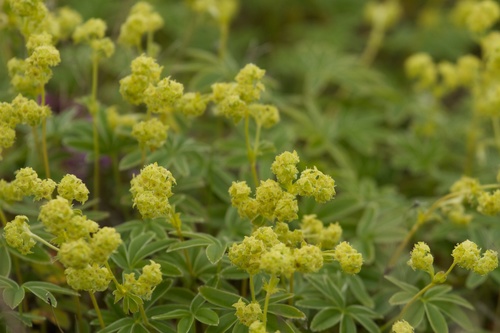
Alpine lady's-mantle, scientifically known as Alchemilla alpina L., is a perennial plant with a woody rhizome, reaching a height between 5 and 20 cm (2 and 8 in). Its weak, silkily hairy stems grow from a basal rosette. The leaves are palmate, with approximately seven lanceolate leaflets that have toothed tips; the leaf upper surface is smooth, while the underside is densely hairy. Stems bear leaves in alternate pairs, and the inflorescence forms a dense cyme. The small flowers are lime green, with four sepals, no petals, four stamens, and one solitary carpel. The flowers are hermaphrodite, and seeds develop apomictically, without fertilization. Flowering occurs from June through September, and seeds can be collected between August and October. Because seeds develop without cross fertilization, any accumulated mutations cause gradual cumulative changes to populations, resulting in many very similar closely related lady's-mantle types often called micro-species. Alpine lady's-mantle can be easily distinguished from other lady's-mantles: its leaves have clearly separate leaflets, while other species have neatly pleated leaves. Alchemilla alpina grows in northern Europe, in mountainous regions further south including the Alps and the Pyrenees, and in southern Greenland. Its natural habitats include moorland, alpine meadows, cliffs, stream banks, and areas covered by winter snow drifts. Ecologically, Alchemilla alpina is a known host to many species of fungi, specifically Botrytis cinerea, Discosia artocreas, Leptosphaerulina vitrea, Mycosphaerella vulgaris, Naeviopsis arctica, Phoma alchemillae, and Ramularia alpina.