About Alcelaphus buselaphus (Pallas, 1766)
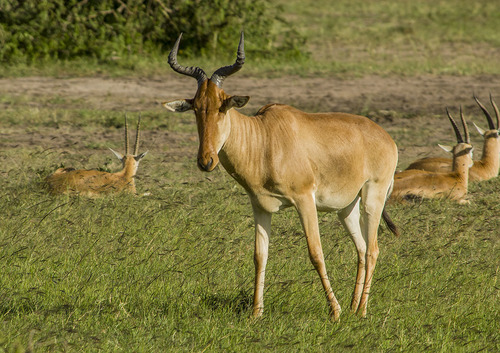
Alcelaphus buselaphus, commonly called the hartebeest, is a large antelope. It stands just over 1 meter (3 feet 3 inches) at the shoulder, has a typical head-and-body length of 2 to 2.5 meters (6 feet 7 inches to 8 feet 2 inches), and weighs between 100 and 200 kilograms (220 to 440 pounds). Its 40 to 60 centimeter (16 to 24 inch) tail ends in a black tuft. Other distinctive features include a particularly elongated forehead, oddly shaped horns, long legs that often have black markings, a short neck, and pointed ears. One study has linked hartebeest size to habitat productivity and rainfall.
The western hartebeest is the largest subspecies, and has a characteristic white line between its eyes. The also large red hartebeest has a black forehead and a contrasting light band between the eyes. The large Lelwel hartebeest has dark stripes on the front of its legs. Coke's hartebeest is moderately large, with a shorter forehead and longer tail compared to other subspecies. Lichtenstein's hartebeest is smaller, with dark stripes on the front of the legs like the Lelwel hartebeest. Swayne's hartebeest is smaller than Tora hartebeest; both have a shorter forehead and similar appearance.
Generally short and shiny, the hartebeest's coat varies in color across subspecies. The western hartebeest is pale sandy-brown, with darker front legs. The red hartebeest is reddish-brown with a dark face, and has black markings on the chin, back of the neck, shoulders, hips and legs that contrast sharply with broad white patches on its flanks and lower rump. The Lelwel hartebeest is reddish tan. Coke's hartebeest ranges from reddish to tawny on its upper body, with relatively lighter legs and rump. Lichtenstein's hartebeest is reddish brown, with lighter tan flanks and a whitish rump. The Tora hartebeest is dark reddish brown on its upper body, face, forelegs and rump, with yellowish white hindlegs and underbelly. Swayne's hartebeest is rich chocolate brown with fine white spots that are actually the white tips of its hairs; its face is black except for a chocolate band below the eyes, and its shoulders and upper legs are black. Hartebeest body hair is fine-textured and roughly 25 millimeters (1 inch) long.
The hartebeest has preorbital glands near the eyes with a central duct. These glands secrete a dark sticky fluid in Coke's and Lichtenstein's hartebeest, and a colorless fluid in the Lelwel hartebeest. All subspecies have horns on both sexes, with females having more slender horns. Horns reach lengths of 45 to 70 centimeters (18 to 28 inches); the maximum recorded horn length is 74.9 centimeters (29 and a half inches), from a Namibian red hartebeest.
Western hartebeest horns are thick, U-shaped from the front and Z-shaped from the sides, growing backward first then forward, and ending with a sharp backward turn. Red and Lelwel hartebeest horns are similar to western hartebeest horns, but appear V-shaped when viewed from the front. Lichtenstein's hartebeest has thick, parallel-ringed horns with a flat base; these horns are shorter than those of other subspecies, curving upward then sharply forward, followed by an inward turn at roughly 45 degrees and a final backward turn. Swayne's hartebeest has thin, parenthesis-shaped horns that curve upward then backward. Tora hartebeest horns are particularly thin, spread out sideways, and diverge more than the horns of any other subspecies.
Apart from its long face, a large chest and sharply sloping back set the hartebeest apart from other antelopes. It shares multiple physical traits with sassabies (genus Damaliscus), including an elongated narrow face, horn shape, pelage texture and color, and a terminal tail tuft. Wildebeest have more specialized skull and horn features than hartebeest. Hartebeest have only slight sexual dimorphism, as both sexes bear horns and have similar body masses; the degree of dimorphism varies by subspecies. Males are 8% heavier than females in Swayne's and Lichtenstein's hartebeest, and 23% heavier in red hartebeest. One study found the highest dimorphism in skull weight. Another study concluded that breeding season length is a good predictor of dimorphism in pedicle (the bony structures that horns grow from) height and skull weight, and the best predictor of horn circumference.
Hartebeest live in dry savannas, open plains and wooded grasslands, and often move into more arid areas after rainfall. They are more tolerant of wooded areas than other Alcelaphini, and are frequently found at the edge of woodlands. They have been recorded at altitudes up to 4,000 meters (13,000 feet) on Mount Kenya. Red hartebeest are known to move across large areas: females roam home ranges over 1,000 square kilometers (390 square miles), while male territories measure 200 square kilometers (77 square miles). In Nairobi National Park, Kenya, females have individual home ranges spanning 3.7 to 5.5 square kilometers (1 and 3/8 to 2 and 1/8 square miles) that are not strongly associated with any particular female group. On average, a female's home range is large enough to include 20 to 30 male territories.
Hartebeest are mainly active during the daytime: they graze in the early morning and late afternoon, and rest in shade around noon. They are gregarious, forming herds of up to 300 individuals, and larger groups gather in areas with abundant grass. In 1963, a congregation of 10,000 hartebeest was recorded on the plains near Sekoma Pan in Botswana. Moving herds are not very cohesive and tend to disperse often. Herd members are divided into four groups: territorial adult males, non-territorial adult males, young males, and females with young. Females form groups of 5 to 12 animals that include four generations of young, and females fight for herd dominance. Sparring between males and females is common. Males can attempt to take over a territory and its female members at three or four years of age. A resident male defends his territory and will fight if provoked, and marks territory borders through defecation.
Hartebeest are remarkably alert and cautious animals with highly developed brains. They are generally calm, but can become ferocious when provoked. While the herd feeds, one individual keeps watch for danger, often standing on a termite mound to see farther. When danger appears, the entire herd flees in single file after one individual suddenly begins running. Adult hartebeest are preyed on by lions, leopards, hyenas and wild dogs; cheetahs and jackals target juveniles. Crocodiles may also prey on hartebeest. The hartebeest's thin long legs let it escape quickly in open habitats, and its formidable horns are used to fend off predators if attacked. Its elevated eye position lets it continuously check its surroundings even while grazing, and its muzzle has evolved to get maximum nutrition even from a limited diet.
Horns are also used during fights between males for dominance during the breeding season; the clash of horns is loud enough to be heard hundreds of meters away. Fights begin with a series of head movements, stances, and depositing droppings on dung piles. Opponents drop to their knees, deliver a hammer-like blow, then begin wrestling with interlocked horns. Each individual attempts to fling the other's head to the side to stab the neck and shoulders with its horns. Fights are rarely serious, but can be fatal when they are.
Like sassabies, hartebeest produce quiet quacking and grunting sounds. Juveniles are more vocal than adults, and make a quacking call when alarmed or pursued. Hartebeest use defecation as both an olfactory and visual display. Herds are generally sedentary, and only migrate during adverse conditions such as natural disasters. Compared to other members of the tribe Alcelaphini (which also includes wildebeest and sassabies), the hartebeest is the least migratory, consumes the least water, and has the lowest metabolic rate.
Mating occurs throughout the year, with one or two peaks that can be affected by food availability. Both males and females reach sexual maturity at one to two years of age. Reproductive patterns vary by subspecies and local factors. Mating takes place in territories defended by a single male, mostly in open areas. Males may fight fiercely for dominance; after this, the dominant male smells the female's genitalia and follows her if she is in oestrus. Sometimes a female in oestrus holds out her tail slightly to signal she is receptive, and the male will try to block her path. Eventually she may stand still and allow the male to mount her. Copulation is brief and often repeated, sometimes two or more times per minute. Any intruders present at this time are chased away. In large herds, females often mate with multiple males.
Gestation lasts eight to nine months, after which a single calf weighing about 9 kilograms (20 pounds) is born. Births usually peak in the dry season, and take place in thickets—unlike wildebeest, which give birth in groups on open plains. Though calves can move on their own shortly after birth, they usually lie in the open close to their mothers. Calves are weaned at four months, but young males stay with their mothers for two and a half years, longer than in other Alcelaphini. Juvenile male mortality is often high, because they face aggression from territorial adult males and are deprived of good forage by them. The hartebeest lifespan is 12 to 15 years.