About Alca torda Linnaeus, 1758
The scientific name of the razorbill is Alca torda Linnaeus, 1758.
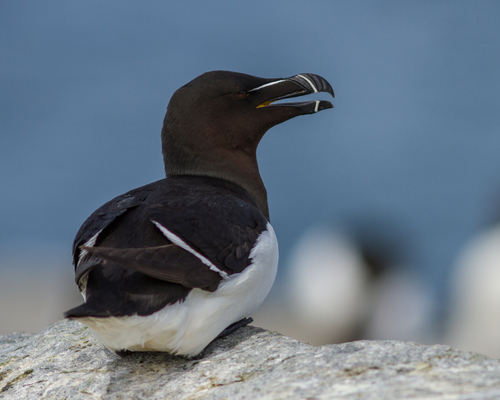
Description: During the breeding season, the razorbill has a white belly, with a black head, neck, back and feet. A thin white line stretches from the eye to the end of the bill, and its head is darker than the head of a common murre. In the non-breeding season, the throat and the part of the face behind the eye turn white, and the white line on the face and bill becomes much less prominent. The razorbill's bill is black, deep, laterally compressed, and has a blunt end. There are several vertical grooves or furrows near the curved tip of the bill, and one of these grooves is marked with a broken white vertical line. In the non-breeding season, the bill becomes thinner, and the grooves are less distinct. As an alcid, it is a large, thick-set bird, with an average weight ranging from 505 to 890 grams (17 3/4 to 31 1/2 ounces). Adult males and females are very similar, with only small differences such as wing length. The total body length of the razorbill is 37 to 39 centimeters. The wing length of adult males ranges from 201 to 216 millimeters (7 15/16 to 8 1/2 inches), while the wing length of adult females ranges from 201 to 213 millimeters (7 15/16 to 8 3/8 inches). When incubating eggs, this species holds a horizontal stance. Compared to other alcids, the tail feathers are slightly longer in the center, giving the razorbill a noticeably long tail, which is unusual for an auk. When in flight, the razorbill's feet do not extend beyond the tail. The average lifespan of a razorbill is about 13 years, but one bird ringed in the UK in 1967 lived for at least 41 years, which is the current record for the species.
Distribution and habitat: Razorbills are distributed across the North Atlantic, and the global breeding population is estimated at fewer than 1,000,000 pairs. Around half of all breeding pairs live in Iceland, and approximately 60 to 70% of the entire global razorbill population breeds in Iceland. Razorbills survive best in surface water temperatures below 15 °C (59 °F). They are often seen alongside the two larger auk species, thick-billed murres and common murres. Unlike most other auks, razorbills frequently travel into larger low-salinity estuaries to feed. They occupy sub-arctic and boreal waters of the Atlantic. Their breeding habitat is on islands, rocky shores and cliffs along northern Atlantic coasts, ranging as far south as Maine in eastern North America, and from northwestern Russia to northern France in western Europe. North American razorbills migrate offshore and south, with their range extending from the Labrador Sea south to the Grand Banks of Newfoundland and on to New England. Eurasian razorbills also spend the winter at sea; multiple populations gather in the North Sea, and some travel as far south as the western Mediterranean.
Known razorbill colonies, ordered from north to south, are: Hornøya, Norway (70°23' N), home to 500 pairs; Grímsey, Iceland (66°33' N); Látrabjarg, Iceland (65°30' N), which held an estimated 230,000 pairs in the mid-1990s, around 40% of the global population, with a breeding season from June to July; Runde, Norway (62°24' N), home to 3,000 pairs; St Kilda, Scotland (57°49' N); Stora Karlsö, Gotland, Sweden (57°17' N), which is the type locality and the largest razorbill colony in the Baltic Sea, holding 12,000 pairs in 2014–2015; Farne Islands, Northumberland, UK (55°38' N), which held 523 pairs in 2022, with a breeding season from May to mid-July; Bempton Cliffs, East Riding of Yorkshire, UK (54°14' N), which held 30,673 pairs in 2022, with pairs present from March to mid-July; Skomer Island, Pembrokeshire, Wales; Heligoland, Germany (54°10' N), which only hosts a few pairs; Gannet Islands, Canada (53°58' N), home to 9,800 pairs; Funk Island, Canada (49°45' N); Île Rouzic, Brittany, France (48°54' N), the southernmost breeding limit in Europe, which had 600 pairs in 1960 but declined to just 30 pairs by 2006; Baccalieu Island, Canada (48°07' N); Witless Bay, Canada (47°13' N); Cape St. Mary's, Canada (46°49' N).
Reproduction: The razorbill has a female-enforced monogamous mating system, and pairs mate for life. It nests in open or hidden crevices between cliffs and boulders. It is a colonial breeder and only comes to land to breed. The annual survival rate of razorbills is between 89% and 95%. Individuals do not start breeding until they are 3 to 5 years old. As pairs age, they will occasionally skip breeding for a year. During breeding periods, mated pairs will court multiple times to strengthen their bond. Courtship displays include touching bills and following one another in elaborate flight patterns. Once the pre-laying period begins, males will constantly guard their mates, pushing other males away with their bills. A mated pair may mate up to 80 times over a 30-day period to ensure fertilization. Females will sometimes encourage other males to copulate with them to guarantee successful fecundity. Throughout the pre-laying period, large numbers of razorbills will gather together, and two distinct social behaviors occur. First, large groups repeatedly dive and swim together in circles, then all rise to the surface head-first with their bills open. Second, large groups swim in a line, weaving across each other while moving in the same direction.